Sunday, 6 November 2011

Real steal: "RA-One"

Bollywood's most expensive venture ever, and its biggest global hit for some time, RA-One skews young - shot in the 3D of countless Western timepassers, released to mark the onset of both Diwali and half-term - but it's no less enjoyable for that. Shah Rukh Khan, in a very funny wig, plays Shekhar, London-based computer game programmer by day, by night an embarrassing dad so dorky he tips anybody who tries to mug him. To impress his delinquent son, Shekhar invents a virtual-reality game boasting the world's baddest bad guy: the eponymous Random Access-One, whose acronym happens to chime with the demonic raavan of Hindi lore. As anyone who's read Frankenstein, or seen Robocop, will have already guessed, such inventions cannot pass entirely without incident: sure enough, the villain soon assumes a life of his own, threatening everything Shekhar holds dear, while also encouraging him to upgrade to the hero status his son badly wants for him.

If you like, then, this is Bollywood disappearing into the same virtual realm its Hollywood equivalent has spent the past two decades giving into; I'm not entirely sure what those grandmothers who sniffled their way through the star's previous smashes Dilwale Dulhaniya Le Jayenge and Kabhi Khushi Kabhie Gham... are going to make of something this pulsing and relentlessly modern. (Does 3D even work on cataracts?) RA-One takes some while setting up the game world, which is presumably where the money went, but this is scarcely an original vision, with scenes and design work that come close to infringing the copyrights on Iron Man, The Matrix and Terminator 2 before it. Seems blockbusters the world over are becoming scrapyards, sorting and welding together the remnants of rusting movie glories, and hoping we'll still accept the offer of a ride.

Aurally, too, RA-One proves altogether familiar: while one recurring musical theme rather wonderfully mashes up Ben E. King's "Stand By Me", another song, "Criminal", recalls less the playback artists of yore than the kind of formula R&B ("It's criminal/The way that booty go pop pop pop") with which Usher and Nelly have clogged up Western pop charts. (It is with a wearying inevitability that I discover said song "features" Akon.) In moments like these, even the core audience may find themselves longing for a form of Hindi cinema Brett Ratner couldn't, or wouldn't know how to, remix. What saves it as widescreen spectacle is that at a crucial point - set up by the introduction of a rose, which may, in a film so profligate in its references, be a nod to Woody Allen - what was once virtual comes crashing into our world, which gives the effects technicians a few days off and director Anubhav Sinha more varied narrative and location options to work with.

So it is that RA-One can be observed scanning for opponents from the top of St. Paul's, flinging parked cars at his nemesis (Shekhar, in the new guise of G-One: "it's Hindi for 'life'", apparently) round the back of Tate Modern, and later causing the wholesale destruction of a prominent Indian railway landmark. In fact, RA-One - like many blockbusters before it - may just contain more of this world than it perhaps realises: it's both dubious and fascinating that RA-One itself originally assumes the form of a Chinese co-worker of Shekhar's, turning at least the first half into a direct battle between China and India for the future of a new generation. Despite the London backdrop, the British are reduced to mere onlookers, left reading the papers on the top deck of one of the double-deckers RA-One careens through, though I enjoyed the knife-wielding hoodie who turns out to be fluent in Hindi, and gets away with his crime: see kids, it really does pay to have a second language.

In the second half, the villain regenerates into a billboard model, which may be a comment on the dangers of capitalism run rampant, or merely a Marxist stretch on my part (the film's opening list of "brand partners" is substantial, to say the least). Whatever, Khan's willingness to play goofy, and suffer repeated damage to his testicular area because of it, is beyond all question, and makes for much of the film's charm; a cameo from Rajnikanth, reprising his role from last year's similarly expensive blockbuster Endhiran/The Robot, is looks-good-on-the-poster windowdressing, though Kareena Kapoor does what she can in the genre-typical role of the loving mum left on the sidelines while father and son work through their parenting issues.

The welcome surprise is that RA-One never gets as sappy as you fear it might (and any direct American equivalent almost certainly would). Instead, the second half relocates to India, and starts tossing fun, sometimes funny ideas around anew: a fat man on a trampoline, say, or the robots interrupting a noisy school trip during a full-throttle train excursion half-inched shamelessly from Tony Scott's Unstoppable. More welding here, then, but the finished product, right down to its cute anti-smoking message, is in one sense the kind of harmless family entertainment Hollywood has forgotten how to assemble. There's no pressing reason why anyone might now, at this moment in cinema history, want to see a Bicentennial Man or Meet Dave done well, but if they did, then RA-One would be it. You certainly get your money's worth.

RA-One is in cinemas nationwide.

Closing the circle: "The Lion King"

Rewatching The Lion King in the digital 3D format, one experiences something of a jolt in encountering all over again the lovingly hand-drawn animation that made the film, whether we realised it or not upon its first release, a clear son of The Jungle Book. (Let's not forget that Disney cannily reissued the latter in 1993, as though to prime audiences for what was to come the following year.) The audience who first came to The Lion King as kids may very well now have kids of their own, inadvertently creating a whole new audience for it; the circle of life, in this particular instance, is not just a philosophy, but a very workable business model.

In truth, the 3D adds but superficial effects: the pleasure here lies in once more being in the same room as one of this studio's strongest (and most economical) acts of storytelling, pitched as it is somewhere between primal prairie myth and Shakespearian history play. Those accusations of racism the film attracted in 1994 - accusations Disney habitually attract - now look shaky, in that the dark-maned Scar is obviously voiced by the Caucasian Jeremy Irons, the best Disney baddie since George Sanders' Shere Khan, while the brave Mufasa is clearly James Earl Jones. (More problematic, it seems to me, is the characterisation of the hyenas - Whoopi Goldberg et al. - clearly demarcated as murderous buffoons, living in an animal ghetto.)

No question, however, that The Lion King nailed its comic relief (while pre-empting an entire nation's fascination with meerkats) in the form of Timon and Pumbaa, logical successors to Rosencrantz, Guildenstern and Baloo, whose songs update "Bare Necessities" with fart jokes; the rest comprises good, sometimes very good songs (even the ballad "Can You Feel the Love Tonight?" and "Circle of Life", which might have been made for a mid-90s world music sampler, are less sappy than I'd remembered), superior schtick ("Lady, have you got your lions crossed") and resonating drum and narrative beats. You can absolutely see why it became the success it did, on stage and screen: in whichever D you see it, it remains a pretty formidable package.

A 3D version of The Lion King is in cinemas nationwide; a Diamond DVD Edition is also available from tomorrow.

Saturday, 5 November 2011

Forward progress: "The Future"

With The Future, the writer, director, performer and performance artist Miranda July gives us a coming-of-age story; the gag is that the leads are both 35. Sophie (July) is a dance instructor with vague artistic ambitions; her boyfriend Jason (Hamish Linklater) a moptopped technical support guy. Together, they are the very model of a young artsy L.A. couple, childless and almost entirely impractical, spending their evenings peering over their laptop lids at one another like a pair of urchins caught up in a game of Battleships. A form of responsibility will be foisted upon them when their cat Paw-Paw falls sick and needs to be taken in to see a vet; the vet insists that, when the cat is returned to them in a month, it will need to be kept inside for the remainder of its earthly existence, which could be as long as five years.

Five years: Sophie and Jason realise - with shared alarm - that this will take them up to 40. Where others would simply buy in more Whiskas and cat litter, these two are so highly strung they're sent into a state of panic by the thought, reasoning instead that this will be their last month of free time and youth, their final thirty days in which to achieve anything truly worthwhile with their lives. In the hope of boosting productivity, they switch off their Internet connection, then set out into the world - she towards a project challenging her to learn thirty dances in thirty days, and an affair with an older man, a brawny, barbequing type (David Warshofsky) whose presence suggests Sophie has a latent desire for domesticity and creature comforts; Jason into the embrace of a global warming awareness organisation enlisting members of the public to sponsor a tree. His supervisor will tell him "you could walk across the city, going from house to house, all the way to the ocean", and you think: don't say that to a character in a Miranda July film, you'll give them ideas.

Ideas The Future has, sure enough: it's partly a treatise on how, in our rush for immediate gratification (and YouTube hits), we've kind of lost sight of the bigger picture, and it's partly a rumination on a particular generation's morbid fear of getting old, where the years beyond fifty are interpreted as "loose change", because they're not enough to get anything one truly wants. How those ideas are expressed has been, and doubtless will be, a sticking point for some: the film is narrated by Paw-Paw, seen as a pair of fluffy handmade paws, whose obs-purr-vations (cat years are much shorter than human years, and you don't see felines having existential crises) at least take the film past the solipsism of its central couple, but are nevertheless voiced by July herself in an electronically modulated ickle-kitty voice, a device I understand has sent many running for the hills.

The film operates at a high frequency, certainly, and yet those who tune into it will pick up some astute transmissions on topics ranging from creative paralysis - take the tableau that finds Sophie procrastinating before a "DAY ONE" cue card, searching for any distraction (a scratch on a floorboard, the metal clasp on a box) rather than have to commit to movement - to our inability to stop time and remain young forever, masters of our own destiny. Even the introduction of the latter sci-fi conceit - marking the point at which the film, and this relationship, decisively bifurcates - is achieved with a particularly Julyian touch: Jason discovers he can stop the clock by holding his hand to Sophie's head, only that his arm, withered by a diet of mung beans and tofu, starts to get tired in the process.

Not so July's eye, thankfully; in fact, her visual sense has never appeared sharper. A sundappled backlawn fantasy has the hazy, ominous light of a Gregory Crewdson photograph; the creepy yellow T-shirt Sophie discovers has a life of its own is too Lynchian to merely be misinterpreted as an instance of a film getting tangled up in its own imagery. The Future is peculiarly stuffed with bodies under blankets and sheets - a consequence of having characters who want nothing more than a sleepy-eyed return to the womb, perhaps, or an attempt to link these characters with Schrödinger's cat: Hamish and Sophie are caught in their own kind of existential limbo, somewhere between youth and old age, the living and the dead. Their relationship doesn't seem to be going anywhere.

If we're inclined to pull back the covers and take a peek, I think we still have to conclude the new film isn't quite as worked through as July's amusingly offbeat debut Me and You and Everyone We Know - sections of it are subject to a dropout of viewer interest, filled with the crackle of some very white noise - but it confirms its director and chief creative force as a talent, and a specifically cinematic talent, if an unruly and divisive one with that. For all July's dotty, sometimes dappy methods, The Future is broadcasting from and to a small but carefully cultivated corner of the real world, reaching, occasionally scrambling for items, ideas and images of relevance. The final scenes, in particular, have the ring of hard life experience, and the future in question is left - as it should be - unknowable.

The Future is in selected cinemas.

Friday, 4 November 2011

Taking a punt: "Jack Goes Boating"

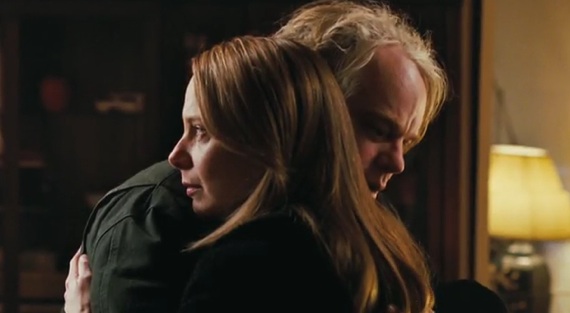
The actor Philip Seymour Hoffman's fairly lovely directorial debut Jack Goes Boating follows the courtship of two individuals of a certain age, and in a particular wage bracket. Jack (Hoffman himself) is a limo driver who finds himself eking out an existence on the wrong side of New York; Connie (Amy Ryan) has a menial job in a funeral home, where she's subject to the wandering hands of her boss. On their first date together, in the snow, they vow they will go boating together in Central Park when summer comes, although there's at least one obstacle between this planned idyll and its realisation: Jack is terrified of water.

The main body of the film, adapted from Bob Glaudini's play, is what happens over the next six months: it is, admittedly, something of an obvious metaphor for self-improvement that Jack should don his Speedos and waddle gamely into the shallow end, but the pool in which he learns to first doggy-paddle, then breaststroke is believably shabby and municipal, for its part. You sense the film, like every last one of its characters, is well aware of its own limitations, and you catch it slowly expanding beyond them. At a brisk 89 minutes, the film is very good on the hectoring pace of modern life: it's full of people trying to make a little time and space for themselves in the face of interventions from friends, colleagues and strangers, and Hoffman directs in some cherishable pauses, which I fear may lead to Jack Goes Boating being mistaken for one of those films in which nothing very much happens.

In fact, a lot happens offscreen here, and the film cocks a snook at romcom convention by making the notional leads' best friends - John Ortiz and Daphne Rubin-Vega, as a married couple who spend these six months attempting to get over a prior betrayal of trust - perhaps even more interesting and complex than the pair we're supposed to be pulling for. These characters live and breathe and yearn between the lines: there's almost no narrative reason for it to be in the film, but Jack Goes Boating gains an extra dimension for the inclusion of the scene where Ortiz, in a plush hotel to pick up a fare, spies a love rival, a chef, putting the final touches to a lavish spread, and - sad-eyed - appears to realise he would be unlikely to bring such delights to his own table.

The rest exists in much the same play-to-film tradition as an item like Marty, in whose heavy footsteps the title character clearly treads: dorky, with a hacky seasonal cough, never quite sure what to say or do or do with his hands or his stringy hair (hence the beanie welded to his scalp for the opening half-hour), Hoffman's Jack is an object lesson in how to play regular and decent without being patronising. Ryan's Connie, meanwhile, nervous around any kind of intimacy after so long on the bench, probably wouldn't know it, but she's little less than ravishing. With the aid of cinematographer Mott Hupfel, Hoffman shoots the actress as she's never been shot before, homely Beadie Russell from The Wire suddenly appearing in a whole new light: this woman's a true catch.

With these characters having thus been set up in our affections, it's a tiny pity they should retreat to the best friends' apartment for an extended bout of late-Act Two doorslamming - as though the film were desperate to snatch back something theatrical from the jaws of an outright triumph - but the home stretch comes through with some poignant and very carefully calibrated material. An unusual romance, then - mature in the best possible sense of the word - Jack Goes Boating takes a punt on a longer game, doing its very best to avoid the flimsy contrivance underpinning so much of our contemporary romantic comedy and drama. And you do want to see Jack and Connie on the lake together.

Jack Goes Boating opens in selected cinemas from today.

Thursday, 3 November 2011

1,001 Films: "Gunga Din" (1939)

Gunga Din is an enjoyable RKO feature, following a trio of sergeants (Cary Grant, Victor McLaglen, Douglas Fairbanks Jr.) muddling through colonial boredom in India by messing around, pulling pranks and wondering out loud how they can get a nice little war going for themselves. Though the murderous Thuggee cult is at large, much of the film plays off writer Ben Hecht and star Grant's genius for comedy; contemporary viewers are likely to be reminded of the recent Three Kings, where another bunch of knockabout recruits went in search of treasure while neglecting what it is they're supposed to be getting on with. George Stevens' film eventually holes up on the Thuggee temple roof as we, along with Kipling's titular hero (Sam Jaffe), wait for something dramatic to happen, and then has to finish with the never-quite-convincing Three Kings finale in which slacker leads turn heroes, but this is mostly rip-roaring entertainment, blessed with some tremendous speeded-up fight sequences, an epic action-adventure of the type so rarely accomplished nowadays.

Gunga Din is available on DVD as part of Universal's Cary Grant Collection boxset.

Wednesday, 2 November 2011

1,001 Films: "Pépé le Moko" (1937)

Julien Duvivier's crime drama Pépé le Moko now looks more than ever like a source of inspiration for Casablanca - but also, perhaps less expectedly, for something like The Wire. We're in Algiers, where a frustrated police force has been reduced to hanging out in the criminal underworld in the hope their prey - in this case, Jean Gabin's master thief Pépé, sheltering in the Casbah - might let their guard down. Given the taut plotting of its immediate Hollywood equivalent, what's surprising is just how much hanging out there is in the wake of the opening police raid: Duvivier is interested in getting a mood, an atmosphere, before shaping a narrative, and there are more songs than there would have been in any Warner Bros. crime drama of 1937 - again, maybe this is where Curtiz and Hal Wallis got the idea for "As Time Goes By" from.

A sense of place is also critical to the whole, for this is surely a prototypical hood movie: a mix of location shooting and superior production design reconstructs the Casbah as a ghetto at least as labyrinthine and encaging as any suburb of latter-day Baltimore or L.A.. "What do you make of this animal?," Pépé asks the mistress of a champagne importer who, with her friends, has come down for the day, clad in her finest jewellery, to see how the natives live, establishing a whole, sad tradition of on-screen slum tourism. Yet the characterisation generally avoids black-and-white extremes in favour of something more shaded. Inspector Slimane (Lucas Gridoux, in what's essentially the Claude Reins role) regards Pépé with wry amusement, moving effortlessly between worlds; the traitorous Regis (Fernand Charpin) is very much in the Sydney Greenstreet tradition of the doomed patsy, and it's with the latter's death that Duvivier reveals a horror and dismay at the fact all this gameplaying should have to result in bloodshed.

If there's one glaring liability, it's right there at the centre of the film, in the form of a romance that proves far less heady and intoxicating than its surrounds: Pépé oversells the charms of the beefy Gabin, a gorilla-in-a-suit whose chestbeating in the central cafe sequence reveals a certain limitation of technique; restrained by Marcel Carné, he was to fare altogether better as the dead man-in-waiting in 1939's Le Jour se lève. And I can't be alone in finding Mireille Balin entirely unsympathetic as a heroine who stands for nothing but material wealth - a big, brassy ring, dripping with diamonds and the promise of a better life, for the anti-hero to paw at. Even if one can see why Pépé might fall for her Gaby Gould, I think you'd struggle to find anything particularly tragic about the outcome of their tryst - which, again, is why Le Jour se lève stands as much the better of these two films.

Pépé le Moko is available on DVD through Optimum Home Releasing.

Tuesday, 1 November 2011

Bullets and bibles: "Machine Gun Preacher"

This is a turn-up - Gerard Butler's first real role, outside that of a smirk with abs. In Marc Forster's drama Machine Gun Preacher, Butler assumes the extraordinary true-life figure of Sam Childers: ex-con and speed-freak biker who, under the influence of his devout wife Lynn (Michelle Monaghan) became first a born-again Christian, then a missionary, rocking up in Sudan in the first years of this century, where he saw at close hand the devastation left behind in the wake of a bloody civil war, and promptly resolved to build an orphanage with his own bare hands. And then, when it burned down, to build it all over again. My sometime comment that Butler has, thus far in his movie career, had the look of a brickie who got lucky is what now makes him exactly right for this part.

To some extent, Childers is but a tweak on that species of bull-headed action figure the star has grown used to playing - the kind of guy who, when he wanted drugs, blasted his way into a squat and took some; the type who, when his family found themselves threatened by a tornado, blasted a hole in the floor of their shack, hid his wife and child there, and then threw himself over the top of it. I doubt there's a job or a region on God's green Earth that Sam Childers didn't think couldn't be fixed with the help of a gun; only when we see him pawning his shotgun collection to buy the orphanage a swing set do we realise quite how serious he is about his new life.

Put this way, Machine Gun Preacher should be utterly preposterous, yet there's a certain degree of fun to be had watching Butler think his way through the contradictions of an individual with a Bible in one hand and a semi-automatic in the other. Sam Childers was fervent, an all-in fellow: he makes mistakes, and sometimes he learns from them and sometimes he doesn't. Butler grants him a dumb likability, and tones down the happy-clappiness: why would you bother clapping the Lord's work, when you can get some of it done yourself with the appropriate firearms?

Everybody else on screen is merely orbiting, but Forster gives them their due when it's required: Monaghan makes the wife role a little tougher than it might have been in other hands, with a run of good scenes when it becomes apparent Sam is torn between his two families - his own, and his kids over there. The wiry Michael Shannon, soon to be seen ripping up the screen in Take Shelter, is a more convincing speedfreak than his buffed male co-star, and his recovery, set in contrast to Sam's, is credibly awkward and erratic. And Souleymane Sy Savane, from Ramin Bahrani's Goodbye Solo, puts enough into his Sudanese liberation fighter to ensure this isn't just another of the award season's white-man-in-Africa fables.

Machine Gun Preacher is such a tall-sounding tale you sense writer Jason Keller has had to compress it a little just to get it on screen; the connecting narrative fabric, explaining how Sam got from A to B, seems scant in places. Yet once he gets past the trailer-park cartoon of the opening act, Forster invests the film with the same middlebrow sincerity that audiences responded to in Finding Neverland and The Kite Runner. The second half gets a little pious and ploddy, as social conscience movies are wont to do, but this is one of those stories that not even a Hollywood in league with the conservative Christian right could entirely ruin: in its better moments, Machine Gun Preacher blindsides you with its faith - with its bold, muscular lunges at portraying human decency and depravity - in a way something as obvious and leadfooted as The Blind Side really couldn't.


Machine Gun Preacher is in cinemas nationwide from tomorrow.