Friday, 10 June 2011

For what it's worth...

Top Ten Films at the UK Box Office
for the weekend of June 3-5, 2011:

1 (new) X-Men: First Class (12A) [above] ***
2 (1) The Hangover Part II (15) *
3 (2) Pirates of the Caribbean: On Stranger Tides (12A) *
4 (3) Diary of a Wimpy Kid: Rodrick Rules (U)
5 (new) JLS: Eyes Wide Open (U)
6 (new) Senna (12A) ****
7 (new) Ready (12A)
8 (6) Rio (U)
9 (5) Fast Five (12A) ***
10 (4) Thor (12A) **

(source: UK Film Council)

My top five:
1. Apocalypse Now
2. Senna
3. Life, Above All
4. Kaboom
5. Cria Cuervos


Top Ten DVD rentals:

1 (1) The King's Speech (12) ****
2 (new) Tangled (PG) ***
3 (6) The Next Three Days (12) **
4 (new) Morning Glory (12) *
5 (2) The Tourist (12) **
6 (4) Due Date (15) ***
7 (3) Meet the Parents: Little Fockers (12)
8 (9) The Social Network (12) *****
9 (new) Burlesque (12)
10 (8) Unstoppable (12) ***

(source: lovefilm.com)

My top five:
1. Inside Job
2. 127 Hours
3. True Grit
4. Eccentricities of a Blonde-Haired Girl
5. Armadillo


Top five films on terrestrial TV this week:
1. The King of Comedy (Friday, BBC2, 11.50pm)
2. Bringing Up Baby (Wednesday, BBC2, 1.40pm)
3. His Girl Friday (Friday, BBC2, 1pm)
4. The Game (Tuesday, ITV1, 10.35pm)
5. Only Angels Have Wings (Monday, BBC2, 1pm)

On DVD: "Inside Job"

With one exceptionally canny soundtrack selection, Charles Ferguson's Oscar-winning documentary Inside Job reveals itself as one of the surest guides yet produced to how our financial system got in its current sorry state. The track in question is Peter Gabriel's "Big Time", and by playing it over the film's scene-setting shots of corporate skyscrapers and white towers, Ferguson immediately establishes how the global meltdown of 2008 came about as a consequence of a certain alpha-male fixation with size.

From a small, manageable, regulated economy, a culture of aggressive capitalism brought us to bigger banks handling more money and rewarding their employees with bigger bonuses - encouraging them to take bigger risks. Blown further out of proportion with the involvement of investment banks and rating agencies, the basic infrastructure was converted into a bigger version of the old numbers racket that held sway over the neighborhood back in the day - only this time, it was on a global scale. Bigger egos and bellies for those who were winning, then - but just as a swelling waistline necessitates looser pants, so too these bankers were soon calling for reduced regulation. Of course, when the bubble eventually burst and we all fell down, it left behind a big mess - and it would be the little people, not the well-insulated bigshots, who were to suffer most for it.

Like the forces Ferguson takes on here, the film is something of a closed shop; it's not one of those activist documentaries that finds it easy to tell us how we might usefully channel our anger. (Although I'd suggest rewatching the end of David Fincher's Fight Club might be a start.) The consolation lies in watching the filmmaker gathering together all the pertinent data in the same place, showing us, in the most methodical fashion, how this heist went down, and then analysing the hell out of these figures for two hours of screen time (or 100 pages of script) in a way rolling news and the print media simply wouldn't have the space for. (Anyone with a fetish for graphs and bar charts will be well away.)

It's all here: the links between politicos and traders, the conflicts of interest that went unacknowledged, the Cassandras who went ignored, the astronomical sums certain individuals walked away with when it all went down, matched only by the monumental arrogance many displayed within the bubble - and (perhaps more surprisingly) in the wake of the collapse. (A standard, recurring defence: "We weren't the only ones with our hands in the till".) This is less of a story than, say, Alex Gibney's Enron doc; like Ferguson's previous No End in Sight (on the Gulf conflict), it's closer in form to a post-mortem, laying the stark facts out before us, and dissecting the financial capillaries to show where the money ran out. Ferguson wields a mean scalpel, both within the editing suite, and in the room with his interviewees. He asks sharp questions, makes pointed interjections - "You can't be serious" to an uptight Dubya aide, "That's not true" to a stammering Federal Reserve chief - appearing unflustered by the prospect anyone might actually walk out on him. (Perhaps as this might illustrate perfectly the short shrift the banking community - and its handsomely paid experts - generally gives to outside intervention.)

The absence of certain key players - their unwillingness to participate - speaks multitudes in itself; those bankers who have agreed to be interviewed appear tanned and sharp-suited - which is to say none of them seem especially haunted or regretful over what they've done, doubtless because they go to sleep each night on mattresses stuffed with the bonuses that continue to creep up, year after year.
There is one notable omission - the perspective of those ordinary citizens whose accumulated debt only accelerated the collapse - but perhaps that's because Ferguson knows his intended audience. Nobody's home, certainly, in the film's frequent shots of boarded-up houses and empty office spaces, of building projects that ground to a halt or were abandoned altogether, and it's with this desolate visual poetry that Inside Job seals its case between the stats and talking heads, as Ferguson indirectly, and in a typically calm, judicious manner, puts the finger on those crooks who will go to their doubtless extravagant graves knowing that they robbed the rest of us blind.

Inside Job is available on DVD from Monday.

"Kaboom" (Metro 10/06/11)

Kaboom (15) 86 mins ***

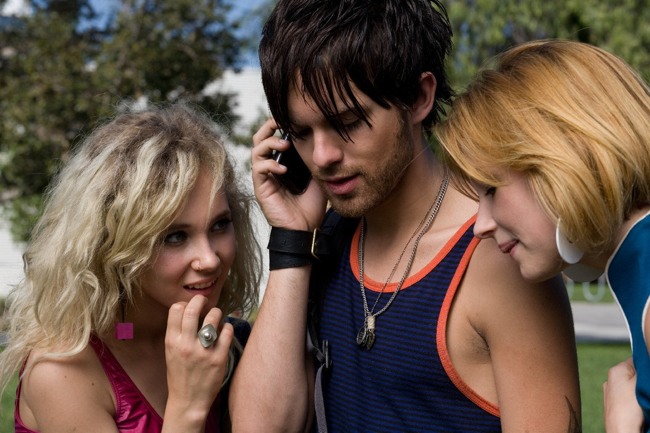
After 2005’s positively respectable Mysterious Skin, indie maverick Gregg Araki here retreats in the direction of his earlier, wilder works with an ethereal college sex romp that plays like Donnie Darko rewritten by Bret Easton Ellis. Horny, blue-eyed pansexual Smith (Thomas Dekker) finds himself distracted from his film studies by first his buff, oft-shirtless yet incontrovertibly straight roommate Thor (Chris Zylka), then a sexually forthright girl called London (Juno Temple). Outside the bedroom, Smith’s having messianic visions, which may just be connected to the freaks in animal masks stalking him around campus.

Cinema at its most bi and curious, it’s compiled according to a vibrant pleasure principle: the colours are cranked up to eleven, and even post-grad characters go under such billings as “Hot-Tub Installing Nudist”. Hip casting lends Kaboom the freshness of just-unwrapped bubblegum – Temple gives the unabashed breakout turn a run of nudging, sniggering Britpics denied her – but Araki then has to fold in everything from witchcraft to Litvinenko-inspired poisonings to prevent any loss of flavour. Poppy fun, ultimately, less transgressive than regressive: the hetero doomsday cult Smith uncovers is every bit as Y2K as the Placebo track accompanying the end credits.

Kaboom opens in selected cinemas from today.

Thursday, 9 June 2011

Fists of furry: "Kung Fu Panda 2"

2008's Kung Fu Panda, one of those what-it-says-on-the-tin propositions, turned out to be a perfectly fine animated offering, overshadowed by the release of Pixar's WALL-E a few weeks later. This was DreamWorks doing a chopsocky movie with cute animals in the place of Jackie Chan or Sammo Hung, and one eye on tapping the expanding Asian market. (Disney had done the same thing ten years earlier, with their hand-drawn Mulan.) That first film predated the 3D revolution, and Kung Fu Panda 2, directed by Jennifer Yuh Nelson, arrives at a moment when audiences have begun something of a counter-revolution: box-office figures show that, in the U.S. last weekend, cinemagoers - finally fed up with hiked ticket prices - expressed a marked preference for the 2D versions of Panda 2 (and Pirates 4) wherever 3D versions were also offered.

This is a slight pity in KFP2's case, since its visuals appear to have been influenced by the work the DreamWorks animators did on last year's 3D success How to Train Your Dragon. Throughout, there's a noticeable attempt to replicate that film's dynamism of motion, how the stereoscopic camera can be used to add extra dimension, if you will, to the characters' fights and flights: Nelson will often shift perspective in the middle of a battle sequence to emphasise the hefty amount of carnage her ursine hero Po is racking up, or - as in one comic sequence late on, where his threats of retribution fall quite spectacularly on deaf ears - just how distanced he is from the real action. In one especially neat flourish, the camera adopts an overhead perspective to better observe the progress of Po and the rest of the Furious Five, clad in a Chinese dragon costume, as they rattle through the backstreets of one small village, recalling Pac-Man in the fabled arcade game. (Presumably, the sequence could be transferred shot-for-shot into any X-Box spin-off.)

What the film works towards, but a committee-produced sequel like this can't quite get at, is the Dragon movie's distinguishing emotion. The attempt at greater depth of feeling is signalled both by a creative-consultant credit for Guillermo del Toro, a master at making generic material affecting, and a narrative that sees Po engaged in the hunt for his true parentage - for the tubby warrior has finally reached an age where he's wondering why his notional father more closely resembles Big Bird than himself. (Po's dreams and childhood reminiscences are rendered in the hand-drawn anime style, perhaps inspired by Tarantino's Kill Bill.) The best material here is better than anything in the original, but there's still a lot of meaningless sound and fury that suggests the filmmakers were stuck for inspiration: discarded subplots include a pack of wolves pillaging villages for metal supplies, making this yet another burger chain-friendly feature that acts green, and sparking a set-piece in a smelting plant that can't help but recall a similar sequence in Toy Story 3.

And while it's admirable these films have resisted the tiring winks to grown-up movies other recent animations have made, elsewhere the KFP franchise has displayed a marked resistance to any humour other than the knockabout kind; with one eye on the overseas market, the other on very young viewers, it prefers cute over funny, and easily translated and consumed above both. As I remarked at the time of the first film, Jack Black is as muted as he's ever been voicing the title character: it's Po's body - his tummy, and his fists - that do all the talking for him. Otherwise, a supporting cast of funny people (Seth Rogen, David Cross, Jean-Claude Van Damme) get maybe one line in twenty to go on. As peacocking villain Lord Shen - who actually is a peacock, voiced by Gary Oldman - sneers at Po, "I find your stupidity mildly amusing", which is likely to be much the response of most accompanying adults. It's not bad, as such - and has the advantage of an easier platform to build from than Pixar's forthcoming Cars 2 - but it remains liable to be shown up by rival animators. The awesomeness of which Po speaks is here strictly serviceable, fleeting, functional.

Kung Fu Panda 2 opens nationwide tomorrow.

Wednesday, 8 June 2011

1,001 Films: "Way Down East" (1920)

Way Down East is the Griffith film cited by those Russian titans Eisenstein and Pudovkin as a source of fascination, and you can see why: tackling the sexual politics of its day - and how it's woman who suffers most for the sins of man - this is a film of considerable modernity, despite being based on an old chestnut of the stage. Lillian Gish plays Anna, a country naif tricked into a fake marriage and then impregnated by a cad during her stay in the city; the bounder absconds, the baby dies, and Anna is taken in as help on a farm run by a family who know their scripture, where the eldest son has been waiting for a girl so seemingly pure at heart, the cad and bounder has his estate round the corner, gossip spreads fast, and the past has a way of catching up with people.

There follows the narrative template for all those subsequent films in which characters crushed or otherwise worn down by the big city find themselves restored by country airs, and urban venality meets its match in rural charity, charms and good humour. It helps that Griffith is working from source material that, rather than contentious (The Birth of a Nation, Broken Blossoms) or over-ambitious (Intolerance), seems perfectly weighted to the cinematic form. The result contains many of this director's funniest scenes (most of the business around the farm) and his saddest (Gish having her child die in her arms), his drollest intertitles and most fully-realised characters.

The dozy Constable Whipple, struggling with his horse, could have come off the pages of Shakespeare; and then there's the Harold Lloyd-anticipating Professor, wreaking havoc with a butterfly net. Even Gish is sparkier and more spirited than usual, right through to the final ice floe sequence - a still-striking shot-for-real action set-piece (those shivers aren't faked) that also allows Griffith to arrive at a great metaphor for a fragmenting society - where you really do care to see her heroine rescued. A work of unfaltering compassion for a young woman tossed to the elements, it's this director's true masterpiece.

Way Down East is available to watch online at lovefilm.com.

1,001 Films: "Broken Blossoms" (1919)

After launching his career - and arguably the entire American narrative cinema - with epics of history (The Birth of a Nation) and civilisation (Intolerance), D.W. Griffith scaled down his ambitions to deliver the 90-minute melodrama Broken Blossoms, charting the relationship between a young waif (Lillian Gish) abused by her prizefighter father, and a Chinese shopkeeper (Richard Barthelmess) who arrived in London to spread peace, discovered opium instead, and may now be the best hope of saving the girl from a life of drudgery.

Though he makes Gish's hateful father somebody "who hates those not born in the same great country as himself", Griffith doesn't exactly seem apologetic about those charges of racism levelled against Birth, inviting Barthelmess to squint his way through the role of a character variously referred to as "Chink", "Chinky" (by the Gish character) and, in the film's own subtitle, as "The Yellow Man". (If the film weren't silent, you'd almost certainly hear Barthelmess saying "Ah so" on a regular basis.)

Gish, tiny and cowering in the bottom corners of the frame like a new-born duckling, also seems too fragile and passive a heroine for a modern eye. The best performance in the film is the towering display of physicality given by Donald Crisp as Gish's father 'Battlin' Barrows, neanderthal of brow, cauliflower of ear; you can read multitudes about the character simply from the way Crisp thrusts his fists into his pockets, and he has a great stumbling death scene. It has dated, but it's still capable of touching the heart and quickening the pulse in places.

Broken Blossoms is available to rent and watch online at lovefilm.com

Tuesday, 7 June 2011

From the archive: "Kung Fu Panda"

The animators at DreamWorks have yet to make a great film - you have only to compare the Shreks to Pixar's Toy Stories to see that - but they've been reliable providers of serviceable school-holiday entertainments featuring characters you might well want to own as merchandise. After the penguins of Madagascar and the colourful turtles and hamsters of Over the Hedge, the latest figure likely to send youngsters scurrying out of cinemas and into the toyshop is Kung Fu Panda's Po (voiced by Jack Black), a cuddly, clumsy bear who dreams of becoming a fighter so great he could "blind his enemies with pure awesomeness".

Unfortunately, Po spends his waking hours working as a humble noodle seller. But when he gatecrashes a ceremony at a nearby temple, the panda is mistakenly appointed as the Dragon Warrior - ahead of such disciplined students as the 'Furious Five', a quintet (comprising a viper, a monkey, a mantis, a stork and a tiger) naturally miffed by this outsider in their midst. Differences have to be set aside, however, when the fearsome Tai-Leung, a snow leopard with the voice of TV's Lovejoy, escapes from prison, set on vengeance against the quintet that put him there in the first place.

A fairly cute confection - its supporting cast of villagers made up of bears, pigs and bunnies - Kung Fu Panda looks to have been conceived in response to the criticism that too many modern animations have been sullied by in-jokes aimed at accompanying adults in the audience. Though it clearly aspires towards delivering an animated version of the martial-arts currently to be seen in the live-action The Forbidden Kingdom (indeed, Jackie Chan provides a voice cameo here), the film refrains from referencing specific chopsocky movies, wisely deciding its target audience would be too young to have seen Enter the Dragon or The Big Boss. Parents have nothing to worry about: though Po's mentor Master Shifu (Dustin Hoffman) insists "the only souvenirs we pick up around here are bloody knuckles and broken bones", the violence takes the form of knockabout comedy in which nobody gets hurt. (The best joke is that Po should be, well, insulated well enough to absorb all the blows he takes.)

As a result, this is a likable if somewhat bland film (Black is on gentler form than he's perhaps ever been), one that inevitably suffers when put up against the dynamism of Pixar's own superhero movie The Incredibles, but also suffers from the same synthetic chinoiserie (cherry blossoms, mountain landscapes) of Disney's 2D Mulan, the last animated attempt to crack the Asian market. The action sequences, at least, offer solid value-for-money, but these things have to be much, much better if they want to enter into the pantheon of modern classics; as it is, a quirk of scheduling fate leaves Kung Fu Panda liable to be knocked aside by the forthcoming WALL-E - yup, Pixar again.

(June 2008)