Monday, 15 November 2010

From the archive: "Harry Potter and the Goblet of Fire"

You should, perhaps, be made aware I am overcoming some major personal prejudice to write this particular review. Increasingly, the experience of discussing the Harry Potter films is rather like what I think it must be like to write for What Car? magazine, in that the product under review is all technicality, with precious little scope for artistry. The Potter franchise is by now a well-oiled machine, calibrated for maximum money-making efficiency. Any changes to director or cast is the equivalent of trying on different nuts and bolts; it's the character of Potter, and J.K. Rowling's holier-than-holy source texts, devoured by children, furtively enjoyed by grown-ups on trains, which provide the engine. (Those of us who object, or simply don't care, are invited to get on our bikes.)

Nonetheless, for Goblet of Fire, the fourth in the series, a pretty good selection of nuts and bolts has been assembled, perhaps the best yet. Director Mike Newell, about whom I was (wrongly) dismissive in my review of HP3, in fact turns out to have been a solid choice: if not a change of oil, exactly, then a reinvigorating new fanbelt. Newell is not an artist - which fits the franchise well - but he is a very able storyteller, capable of spinning yarns both light (Four Weddings & A Funeral) and dark (Donnie Brasco). HP4, accordingly, has more of a sense of shaped narrative, rather than the scenes-ripped-literally-from-the-book approach that made parts one to three such a chore in places to sit through.

This one actually has two competing strands: an inner story and an outer story. The outer story is the eminently widescreen business of the Tri-Wizard Tournament, which should already be familiar to lovers of the books. The inner story provides the more compelling business: the three lead characters discovering their hormones and coming this close to breaking up forever. Hermione (Emma Watson) is seen in several sequences with a new (platonic) girlfriend, never introduced to the rest of us, while Harry (Daniel Radcliffe) and Ron (Rupert Grint) have a full-on teenage-boy tiff. Ron tells Harry to "piss off" (which is shocking in the context); Harry calls Ron "a foul git" (which is very Harry).

The inner story does rather get in the way of the outer story - the whizzy peril of the Tournament gets forgotten about as everyone fusses around in preparation for a ball - but yields one of the film's most enjoyable sequences. Here, Harry and Ron, best of friends again, sit grumpily in a corner of the Hogwarts' ballroom, ignoring their dates' pleas for a dance - moments of screen time that work not just because they conjure up memories of school discos past, but because the scene forms something of a summation of the Potter experience for non-devotees such as myself: sitting on the sidelines, wondering quite what all the fuss is about, while everybody else seems to be having a high old time.

This is the first Potter movie to find time and space for those sidelines; the previous three, frantically attempting to get every last page of Rowling into a film lasting under three hours, were all clutter and action, all front and centre. Of the new performers aboard, to which we might ungallantly but not inaccurately refer as "the bolts", we have Brendan Gleeson as scarred professor "Mad Eye" Moodie, swigging from a hipflask beneath the mechanism that gives him that nickname; Miranda Richardson as a gossip columnist, wearing apparently the same hairstyle as she did for Newell in Dance with a Stranger; and The Constant Gardener (or English Patient) himself, Mr. Ralph Fiennes, who turns up as the devilish Lord Voldemort in an intense last-reel that dares to recall Lynch at one point, as Timothy Spall's henchman receives his orders from a creature that resembles the grinning homunculus of Lost Highway.

The franchise certainly feels a lot more grown-up with Newell in charge, opening with skulls and snakes, closing on death in a graveyard and - between these two markers - throwing in the series' first swearwords and topless scene (Harry, not Hermione). This may come to be considered as the Potter films' The Empire Strikes Back, and the efficient yet self-effacing Newell its Irvin Kirshner. The hope is that Goblet's inevitable worldwide success will encourage the producers to select for film five a director capable of running with this darkness, rather than resorting to Ewoks, or whatever the Potterworld equivalent is. (Where is Dobby the House Elf these days, anyway?)

To this end, I hereby submit for their consideration a list of directors who might have fun with the Order of the Phoenix: Larry Clark (it's not just Harry who goes topless, and it's not just topless); Quentin Tarantino (Dumbledore goes medieval on Voldemort's ass); Richard Linklater (he has ties to Warner Bros., and proved he could direct kids in both School of Rock and Bad News Bears); Gaspar Noe (tell the story backwards, for once, to shake it out of its rut); Whit Stillman or Hal Hartley (because they need the work); Danny Boyle (because he proved, with Millions, that it is possible to retain a distinctive sensibility while making a family entertainment that appeals to a wide audience). Failing that, turn the whole franchise over to Nick Park and do the remaining books as claymation: Harry Potter's Wheel, anyone?

(December 2005)

In retrospect, the author would like to apologise for that last pun.

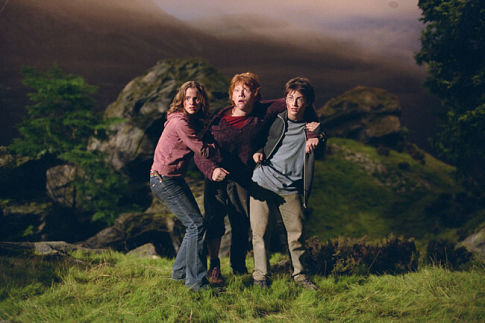
From the archive: "Harry Potter and the Prisoner of Azkaban"

One of the potentially interesting aspects of the Harry Potter franchise is that, as the series goes on and its central characters age, the target audience will get older, allowing for the possibility that subsequent instalments might come in at a 12A or even 15 rating. The latest film, Harry Potter and the Prisoner of Azkaban, has been directed by Alfonso Cuaron, a past master of magical fairytales (Warner Bros.' A Little Princess), literary adaptation (Great Expectations) and horny teen pics (Y Tu Mama Tambien). Cuaron employs a notably darker visual palette here, taking his cue from the name of the deranged wizard who haunts the series' third entry: Azkaban is, one is led to expect, the film where the Potter franchise gets Sirius and goes Black.

This is a shadier film than Chris Columbus's first two - its skies are overcast for the most part, its title rendered in cold, steely silver rather than the golds that lit up the screen previously - and in a world of baffling climate change (all sun-dappled fields one day, thick snow the next) which unintentionally comes to represent Warner's uncertainty over this latest instalment's release date (previous Potter films were Christmas releases), Cuaron's eye for the natural world is self-evidently stronger than his predecessor's. Frustratingly, though, the formula remains much the same: no one director is ever going to alter this lucrative a brand, and Azkaban duly turns out to be the sort of film that will prove, if not the death of auteurism exactly, then a perversion of it, where the author of the original source material (J.K. Rowling) holds greater sway than the talented screenwriter and director adapting it, and where the latter two have been paid too much for their services to do anything other than assemble the required pieces in the prescribed order. The next film in the series, based on the longest of the published books to date, is to be directed by the defiantly unspectacular Mike Newell, so don't go expecting any changes there.

Of course, none of this matters if you just want your movies to do a job, to be, well, functional: Harry Potter and the Prisoner of Azkaban will play in a lot of cinemas, where it will make a lot of money for some already very rich people. On the plus side, Steve Kloves' screenplay is a little leaner - there's less Quidditch (the literary world's most pointless sport) in a rain-affected match - and this film comes in a good quarter of an hour shorter than the previous two. (It could have been shorter still: a time-travel device means the final half-hour, like much of the rest of the film, comes to repeat on itself - a side effect of mass consumption, I guess.) The new additions to the Hogwarts faculty (Emma Thompson, David Thewlis and Michael Gambon, replacing Richard Harris as Dumbledore) are welcome. And the opening scenes - mired in suburbia once again, with Richard Griffiths and Fiona Shaw as the step-parents from hell - play even more like a kiddie version of Abigail's Party; this time round, we get Pam Ferris as Griffiths's bloated sister, and Jim Davidson's Generation Game on the telly as the ultimate signifier of bourgeois hell. (How on earth did the American Kloves and the Mexican Cuaron come up with that?, you wonder.)

The Mike Leighisms apparent in both casting and characterisation are underlined during a showdown late in the film that puts three of Leigh's leading men in the same room, almost too great a coincidence for a film as impersonal as this to handle. Like the 007 films, Potter is now so established as a profit-turning exercise, with a hero so essentially untouchable, that the mind drifts off during the slower patches to consider what even more individual filmmakers, such as Leigh, might make of the assignment: one clings to the vain hope there might yet be an improved, hand-held Dogme movie somewhere in future Potter books. Azkaban's one stand-out feature is that while Emma Watson's Hermione and Rupert Grint's Ron haven't developed much beyond their stock roles of posh bird and proletarian oik, the central character is being increasingly shaped by actor Daniel Radcliffe's own personality.

Out of his school uniform, this Potter sports a haircut, the leisurewear and a series of temper tantrums that wouldn't appear too far out of place adorning the lead singer of an indie band beginning with the definite article. (Further credentials are supplied by an early cameo from - I kid you not - Ian Brown of The Stone Roses, whose presence momentarily threatens to turn The Leaky Cauldron into a wizardly equivalent of the Met Bar.) The good news for Rowling, Warner Bros., any future directors of these films, and their accountants is that - even as the formula around him has settled into hat as old as the one on Dumbledore's head - Harry Potter just got cool; as cool as the teenage hero of a multi-million dollar corporate franchise based on a best-selling childrens' books can get, at any rate.

(May 2004)

Saturday, 13 November 2010

From the archive: "Harry Potter and the Chamber of Secrets"

Spare a thought for the traditional British pantomime. For centuries, it used to be the case that parents and guardians would take their offspring to their local theatres around this time of year to spend between two-and-a-half and three hours watching jobbing actors exchange harmless innuendo in between bouts of knockabout action designed to pull out the latter-day relevance in timeless, classic texts. The pantomime has been under threat for several years now, with audience numbers falling and theatres closing, impresarios being quick to put the blame on "more sophisticated forms of entertainment", reasoning the youngsters would rather play Super RoboDino Smack 'Em Up 2 on their Cubic Playbox than spend their afternoons shouting "He's behind you" and "Oh no, he isn't" at fading TV soap stars throwing M&Ms into a crowd.

Now that the Hollywood holiday-season blockbuster has become all-consuming, I can't help feeling the essence of pantomime has been sublimated into film - more specifically, those films released during the months of November and December in a bid to close all non-movie theatres down. This spirit finds its purest expression in cinemas this year: the harmless innuendo (which always did go over the heads of the younger audience) in the PG-13 rated Bond; the knockabout action (which always could get a little intense) into the new Lord of the Rings; the tendency towards an ensemble of familiar faces giving larger-than-life performances, meanwhile, now finds its way into the latest Harry Potter film.

For centuries, the basic formula of pantomime - the schtick that makes it tick - has gone unaltered. It's been amusing, over the past few weeks, to hear cutting-edge Hollywood filmmakers - chiefly those involved in the Bond film - talking like old panto hands, asserting it would be folly indeed to tamper with an established formula, and that the consequences of any such tampering (aside, of course, from a likely dip in box-office takings) would be unthinkable. Series helmsman Chris Columbus, similarly, daren't step off this party line; that's something you sense in every frame of Harry Potter and the Chamber of Secrets, which - for its first half at least - plays almost identically to his debut Potter outing. There's the escape from dreary suburbia; a bit of business with the Hogwarts Express train; an early class in which class idiot Neville (Matthew Lewis) will make a fool of himself; a lengthy sequence of abstruse game Quidditch; and eventually - very eventually, over an hour into the film - some semblance of a plot coming together.

Still, maybe this familiarity is comforting, and it's not difficult to see why these books - and these films - speak volumes to children. In a panto like Jack and the Beanstalk, poverty is conveyed in terms of having to sell your last cow for a handful of magic beans. The legend of J.K. Rowling is that she wrote the first few books while living as a single mother in a run-down tower block. Whether or not this is true, it shows through in the abuse Rupert Grint's Ron Weasley gets for his second-hand wand and textbooks (something that's bound to strike a chord with anyone who's ever been envious of their classmates' trainers) and in the way Hermione (Emma Watson) gets labelled with the worst slur imaginable in this world - "mudblood", meaning of mixed (i.e. non-wizardly, and here subsequently lesser) descent. Despite the Warner Bros. production values, these remain films about classes, in every regard.

Last year, I made idle speculation about the fate of the franchise's juvenile leads four or five films down the line, by the time they should logically be reaching puberty. There's certainly a sense of the characters growing up here. Hermione develops a crush on new teacher Gilderoy Lockhart (Kenneth Branagh); Harry gets in a sticky situation on account of Ron's sweaty palms; and, indeed, the entire action element of the film is kickstarted when the two boys steal away in a car, staying out all night, and risking the wrath of Mrs. Weasley (Julie Walters). The kids give more or less the same performances: though Watson has wisely toned down the stage-school precociousness, Grint continues to gurn and grimace wherever possible. These, though, are Radcliffe's films: if he didn't know it before the multi-million dollar success of Philosopher's Stone, he does now, and he shows all the signs of a young actor seizing a golden opportunity with both hands.

The adult performers fare less well, too often reduced to spectators in the plot or relegated behind special effects; certain players display a tendency to do all their acting with the lower part of their face, adopting either a Blair-like rictus grin (Branagh) or the pained expression of someone who's spent several hours in the dentist's chair (Alan Rickman), which perhaps reflects a subconscious discomfort at having lines in their mouths that every parent in the audience will already have spoken aloud at least once. Few viewers will have played Hamlet - as Branagh has - but the part of Lockhart is being played out in bedrooms across the land every night just before bedtime. That said, the most dramatically satisfying scene in the movie is the one where Lockhart and Snape stage a spells demonstration in Hogwarts Great Hall, which begins in comic mode but shades into something else entirely as Harry discovers his dark side.

Still the most amazing feature of the first two HP films is the involvement of writer Steve Kloves, best known for the minimalist atmospherics of his directorial credits, and The Fabulous Baker Boys and Flesh and Bone. Both Philosopher's Stone and Chamber of Secrets are simply too long, and there's a reason for their being too long that goes beyond the need for a better script editor. A few examples of this latest film's excesses: Hermione turning into a cat is a reasonable sight gag, but it doesn't affect the plotting and slows the action down just when we want it to pick up a bit; Quidditch still makes no sense as a sport, because once again, the putting of balls through hoops turns out to be an irrelevance when Harry makes a single catch to win a game; and there's a scene in a giant spider's lair that jazzes up some exposition in the script, but feels as though the effects house has intervened to try and use up a few of the CG arachnids left over from Eight-Legged Freaks. And after all the mayhem, the plot is resolved arbitrarily.

The reason these films are too long - and there's every reason the remaining films in the series will be just as long again - is that millions of children around the world have now read the Potter books, and every last one of them will have their own favourite moment. If it's a no-risk proposition to adapt for the screen the world's biggest-selling series of children's books, it's then even less of a risk to adapt everything those books contain. The executive's fear has to be: if you leave out one child's favourite bit, they won't come back for the remaining movies. That's why there's ultimately something a bit cowardly about Warner Bros' approach to the Potter films to date, and why we're back to Hermione turning into a cat again: the effect is intended as magical, but entails a bit too much pussy-footing around. It'd be a hard heart that couldn't find something positive to say about such a handsomely mounted, lovingly produced and (risk be damned) comprehensive adaptation: as in Philosopher's Stone, the cast has been stocked in sufficient depth to keep adults interested, and the odd flash of true movie wizardry will doubtless keep youngsters enthralled. Just take them to a pantomime afterwards. If you can find one.

(December 2002)

[And yes, I can appreciate the irony of taking eight whole paragraphs to denounce a film for being too bloody long; blame the exuberance of youth.]

From the archive: "Harry Potter and the Philosopher's Stone"


In a year in which the American summer blockbusters were exceptionally poor, it's left to British- and Antipodean-flavoured films to vie for the title of 2001's best event movie. If you haven't heard a thing about the Harry Potter film in the last twelve months, you're either the last bastion holding out against the forces of globalisation, or you've been locked away in post-production on the Lord of the Rings movie. Being perhaps the best-known fictional character in the Western world at the moment, this big-screen adaptation of the opening chapter in J.K. Rowling's saga of the boy with the Zorro scar on his forehead starts out with a suggestion of what makes Potter such an icon of the modern age: that he is, right from the off, a celebrity. The opening hour of Harry Potter and the Philosopher's Stone, in which friendly giant Hagrid (Robbie Coltrane) plucks wizarding boy wonder Potter (Daniel Radcliffe) from suburban hell, is really all about what it means to have one hundred heads turn your way whenever you enter a room or, in scenes that play like premonitions of life in Rowling's flat today, have a gazillion letters demanding your presence flood your letterbox, or have people breaking down your doors to find out the real story behind the boy who brings magic to the lives of all those with whom he comes into contact. 

Once Potter enrols at Hogwarts Academy, the film is more interested in what it might be like to be a big fish in a small pond, as Harry, known to all his teachers as a major talent, is picked on by his rivals and finds it hard to live up to what's expected of him - because, as we all know, it's tough being a celebrity. One of the joys of the film is this recreation of British private school education, for which we presumably have Rowling, and not American director Chris Columbus or screenwriter Steve Kloves, to thank. Next to everything within the Hogwarts universe - from Alan Rickman's science-lab tyrant and the ancient house system to what happens when someone falls off their broomstick or a troll (the film's equivalent of a cigarette fire) breaks out in the girls' bathroom - feels perfectly realised. The glaring exception is Quidditch, the high-speed ball game that takes place on and over a field round the back of the Academy, which is exactly the sort of arcane sport encouraged by those in private education, but demonstrates that Rowling, for all her grasp of character and story, has little real feeling for the rules of a game: why would a Quidditch player bother to throw balls through hoops, when they could win a match with a single catch? 

With its cool effects for the kids and funny, eccentric character turns for accompanying adults, Rowling, Columbus and Kloves have stocked the film in depth, both a strength and a weakness. This world folds back in on itself, as Harry and best friend Ron Weasley (Rupert Grint) consume the sweets and trading cards that will no doubt make up the bulk of the Potter merchandise, coming soon to a store near you, but at least one of the executive producers looks to have held out for an emphasis on the expressiveness of human faces over CGI, on character development above marketing opportunities. That said, this is a good blockbuster rather than a great one, stuck as it is with a wildly erratic selection of juvenile performances. Radcliffe underplays the role successfully, and while Grint is there mainly to provide salt-of-the-earth contrast to the lead's supernatural self-possession, too often he seems to be auditioning for the Jason Flemyng role in another Guy Ritchie about public-school geezers. Worse still is Emma Watson's Hermione, a character - and a performance - so shrill and arch as to be downright embarrassing at times. All of them have their moments, but the final forty minutes spent in their company, during which the plot signalled by the title eventually kicks in, do feel a little like being kept behind after class for a reason one can't quite fathom. Still, it'll be interesting when we get to the seventh Potter film, by which time Hermione will have become a preening sixth-form sexpot, Ron will be suffering from his first bad spell of acne, and Harry will be seeing who knows what "desperate desires" in the fabled Mirror of Erised.

(October 2001)

For what it's worth...

Top Ten Films at the UK Box Office
for the weekend of November 5-7, 2010:

1 (new) Due Date (15) [above]
2 (new) Jackass 3D (18) **
3 (2) Despicable Me (U)
4 (1) Saw 3D (18)
5 (3) Paranormal Activity 2 (15)
6 (4) RED (12A)
7 (5) The Social Network (12A) ****
8 (new) Let Me In (15) **
9 (new) Another Year (12A) ****
10 (6) Burke & Hare (15) **

(source: UK Film Council)

My top five:
1. A Day in the Life - Four Portraits of Post-War Britain
2. Another Year
3. We Are What We Are
4. My Afternoons with Margueritte
5. Skyline


Top Ten DVD rentals
:

1 (1) Iron Man 2 (12) ***
2 (4) The Blind Side (12) **
3 (2) Killers (12) **
4 (3) Brooklyn's Finest (18) **
5 (8) Prince of Persia: The Sands of Time (12) **
6 (5) The Ghost (15) **
7 (new) Heartbreaker (PG) **
8 (new) Disney's A Christmas Carol (PG) **
9 (6) Black Death (15) ***
10 (10) The Girl with the Dragon Tattoo (18) ***

(source: lovefilm.com)

My top five:
1. A Town Called Panic
2. How to Train Your Dragon
3. Wild Grass
4. Collapse
5. The Karate Kid


Top five films on terrestrial TV this week:
1. In the Line of Fire (Thursday, five, 9pm)
2. The Dirty Dozen (Saturday, five, 5.45pm)
3. The Spiral Staircase (Friday, BBC2, 1am)
4. Eye of the Needle (Wednesday, C4, 12.50pm)
5. A Dirty Shame (Thursday, C4, 2.30am)

Friday, 12 November 2010

"You Again" (The Scotsman 12/11/10)

You Again (PG) **
Directed by: Andy Fickman
Starring: Kristen Bell, Jamie Lee Curtis, Sigourney Weaver


Disney is running out of starlets: with Lindsay Lohan off-limits and Demi Lovato out of action, You Again provides a showcase for Kristen Bell, the brittle blonde whose TV work (Veronica Mars, Party Down) remains preferable to her movie choices (When in Rome, Couples Retreat). Here, Bell’s PR hotshot Marni is less than happy to discover her brother is poised to wed the cheerleader (Odette Yustman) who made her high-school years hell; the potential social nightmare is only redoubled by the fact the happy couple’s respective mothers (Curtis, Weaver) themselves have unfinished business from prom night.

The weird, 80s-worshipping times may mean we’re in for a rash of these
extended family-values sitcoms, and this one’s sitcommier than most, with bits for ex-Golden Girl Betty White as a horny grandma, hugs and healing crowding out actual laughs, and notionally comic dance-offs – to Britney’s “Toxic” and (inevitably) “We Are Family” – that prove as cringeworthy as anything witnessed at any real-life reception. All soft furnishings and gleaming teeth, it’s an inoffensive proposition, made for in-flight viewing – but anybody expecting another Freaky Friday or Mean Girls will be sorely disappointed by the lack of fizz and bite.

"Skyline" (The Scotsman 12/11/10)


Skyline (15) ***
Directed by: The Brothers Strause
Starring: Eric Balfour, Donald Faison, Scottie Thompson

The pre-publicity promised vast, Independence Day-like spectacle, but this reined-in alien-invasion feature instead appears a canny piece of bet-hedging from the Strause brothers, being a functional B-movie that might someday be retooled as a pilot for the SyFy channel. A group of well-to-do twentysomethings gathered in L.A. to discuss a business venture are distracted from their margaritas by bright blue lights descending from the sky – an advance party, it turns out, for alien crafts who come to hoover up unfortunate earthlings, and unleash several kinds of tenticular mayhem.

The look owes much to Cloverfield and District 9, but the Strauses make nice use of the between-seasons TV talent available to them. Scrubs’ Faison is the cocky producer who finds his Ferrari no help in the circumstances; 24’s Balfour the out-of-towner facing up to increased responsibilities; best of all, Dexter’s foursquare David Zayas is the concierge who comes through whenever the kids are in danger of losing their heads. There’s no time for subtexts – the aliens, like the film, could do with a mite more personality – but it has a couple of genuine surprises, and few pretensions about delivering an efficient, popcorn-worthy entertainment.