Sunday, 26 September 2010

Back to "Back": Notes on the return of Marty McFly

At last, the first must-see blockbuster of 2010. After a summer spent watching pre-eminent American producers scrimping and saving (Prince of Persia; The Losers), or reaching for 3D as a revenue-generating last resort (Clash of the Titans), it's a greater pleasure than usual to return to Back to the Future, and an era when the major studios had both money to burn, and some confidence in what an audience might want to see of a Friday evening. The reputation and reach of Robert Zemeckis's 1985 film has only grown in the years since: giving boyband McFly their name, for one, and sparking a flurry of erroneous Tweets earlier this year when some bright spark Photoshopped the time-travelling DeLorean's readout to suggest this was the year Marty and Doc were all set to zoom off to in the closing moments. (In fact, their destination is 2015 - so you've got five years to devise your next witty BTTF-derived Facebook update, providing the Mayan prophecy set out in 2012 doesn't intervene.)

Final-scene pleas for sequels have become commonplace in event movies - but this boyishly charming film remains one of the few where the process of sequelisation feels thoroughly earned by that conclusion. It's a toss-up between this and the no less pop-culturally savvy E.T. for the title of The First Truly Self-Aware Blockbuster - which may be the reason BTTF gets away with this much Huey Lewis, not only on the soundtrack, but in the singer's brief cameo as the high-school music teacher who judges Marty's band "too loud". (At the risk of going all Patrick Bateman on you, I've always found "Back in Time" preferable to "The Power of Love", the then-ubiquitous break-out single, positioned front and centre as the film opens.)

The two-man Libyan terrorist team operating out of a VW camper van now seems a quaint touch, but otherwise irony and hindsight are as central to the narrative structure as the flux capacitor is to the DeLorean, as is a sense of things and wonders to come: while following Marty's progress, Obama-era viewers might care to consider in passing the less pyrokinetic (yet more significant) journey undertaken by Hill Valley's foremost black resident, Goldie Wilson, in proceeding from put-upon busboy to mayor. (Some compensation, possibly, for the Enchantment Under the Sea sequence, where Marty's rendition of "Johnny B. Goode" apparently gives no less an individual than Chuck Berry the idea for rock 'n' roll - which, while funny, smacks a little too much of white moviebrats trying to reclaim rhythm 'n' blues for themselves.)

The question of historical perspective hovers over the film throughout. It's not too difficult to read BTTF as an attempt to rewrite American history along conservative lines, flat-out ignoring the 1960s (too progressive) and the 1970s (Vietnam); as Marty's grandfather says at the family dinner table, "Who the hell is John F. Kennedy?" Zemeckis and co-writer Bob Gale take a hard line on crime: poor Uncle Joey, announced as a jailbird in 1985, is confined to a playpen in 1955, and resigned to his fate. ("Get used to those bars, kid," Marty urges the nipper.) What the film does achieve is to unify the conservatism of the 1950s with its 1980s equivalent - to make momentary sense of how Ronald Reagan rose from Hollywood bit-player in one time frame to most powerful man in the world in the other. "No wonder your President is an actor," 50s Doc proposes, marvelling at Marty's unmarvellous, briefcase-sized JVC camcorder, "He has to look good on camera!"

For Marty, the journey is - as he puts it in his closing words to 50s George and Lorraine - "educational", chiefly about discovering that his folks, schlubbily sexless and wholly uncool in the present tense, once had desires similar to his own: the film is unusually sophisticated in its appeal to both adult and teenage audiences. This being a PG-rated family feature, it isn't, of course, allowed to go too far: yes, Marty ends up in his own (younger) mother's bed, stripped down to his purple Calvin Kleins, and yes, the two of them very nearly kiss - ew! - in the car park before the dance, but clever plotting means fate intervenes whenever matters threaten to get too far out of hand.

It's the upside of Twin Peaks, which similarly meshed the 1950s with a more contemporary aesthetic and morality, but plumped for the unhappy ending: there, Laura Palmer found out the hard way about the needs of her parents. It may not be coincidence that the tramp roused from his slumbers by Marty's return to the present is none other than Jack Nance, the regular Lynch player caught napping somewhere in time between Eraserhead and Twin Peaks. And what of BTTF's Twin Pines Mall, eventually reduced - in one of the film's subtlest gags, thrown away late on - to the Lone Pine Mall after Marty ploughs the DeLorean through Old Man Peabody's prized front yard?

For all the above speculation, Back to the Future remains not just a model, but a miracle of crisply economical screenwriting: after the opening half-hour of pure, undiluted set-up, Zemeckis and Gale manage to resolve the George-and-Lorraine subplot within 90 minutes, a feat which - in this age of unspeakably flabby blockbusters - serves as its own testament to just how hard that middle hour works. In fact, the film proves in such a rush to set up a sequel for itself that another look reveals how the screenwriters bungle the ending. Viewed objectively, the world hasn't improved when Marty returns to the present; it's just shifted its axes. Now George is the big-shot, rich off the back of his (terrible-looking) sci-fi opus A Match Made in Space, and Biff is the one reduced to menial labour. The dynamic is still that of bully and victim, only now the McFlys have a nice new car in the garage: this was 1985, after all.

Back to the Future returns in selected cinemas from Friday.

On DVD: "Mother"

No-one is having more fun with genre right now than the director Bong Joon-ho. You may remember the name from 2006's monster mash-up The Host, which pitted a dysfunctional family of misfits against a giant amphibian creature emerging from the Han river, but seasoned Bong-ites have been spreading the word since 2003's outstanding Memories of Murder, which took a melancholy tale of true-life serial-killing that shocked Korea, and added grace notes of crime-scene and interrogation-room knockabout: it kicked its characters up the backside, and then - once the laughs had subsided - left us feeling a lingering pain and sadness.

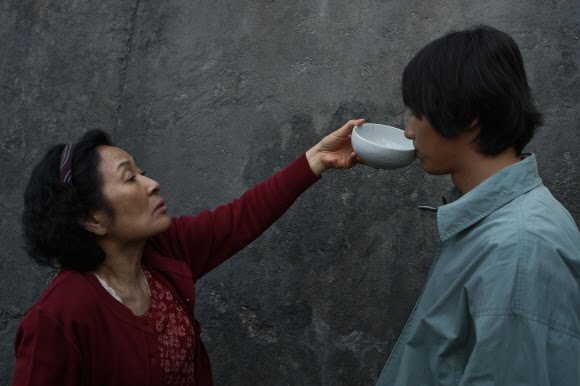
Trace elements of this latter film resurface in Bong's latest, Mother, which sets out as an offbeat detective story about a provincial simpleton framed for the murder of a young girl he drunkenly followed part of his way home one night. The police are convinced the murder was the accused's way of proving himself anything other than nice-but-dim; the only person who believes in his innocence - who refuses to give up on him, even as his own lawyer retreats to a nearby karaoke bar, clutching a plea bargain - is his dear Mum. She's sure her boy couldn't have done it, because it's she who was sleeping next to him (albeit on the other side of the covers) that evening. Now that's an alibi.

It could have been a fairly distasteful one, too, adding another mother to that pantheon of creepily possessive movie matriarchs that includes Mrs. Bates and Mommie Dearest, and even Debbie Reynolds, fussing over Albert Brooks in the American comedy of the same name. Yet Bong rather admires this momma's pluck and resilience, her willingness to go to places nobody else will to plead her son's case: to a wake for the deceased, for example, where the dead girl's own mother is pointedly shown checking her reflection in a framed portrait of her daughter; or into the heart of an all-male squadroom, dispensing treats to all and sundry as she goes; or - when push comes to shove - into a suspected murderer's lair armed only with a set of acupuncture needles.

The mother is driven by her lack of vanity, a kind of blithe, imperious selflessness, a desire to help out (some might say interfere) wherever possible - heightened versions of characteristics displayed by good-to-great mothers everywhere. The real devilish joy lies in the detail Bong embroiders into this yarn: the detective who, William Tell-like, practises his obscure martial art with the aid of a desk drawer full of apples, the never-explained sex game observed from the closet of one suspect (very Blue Velvet, this) that involves the participants breaking words down into their constituent syllables. Bong is doing much the same himself: dismantling anything remotely familiar, and reassembling it in ways that seem fresh, appealingly strange - heck, even stimulating, if it's the sort of thing that floats your boat.

Scarcely a moment in Mother is wasted - which makes it a more compact proposition than the expansive, CG-enhanced The Host - and it's cast superbly, in such a way as to finesse any bumps or joins from scene to scene. As the ma in question, Kim Hye-ja proves an indelible combination of Miss Marple and habitual worrywort, fussing over her offspring even as he lets rip with a stream of urine at a bus stop, and managing against all the odds to retain some degree of sympathy even after the revelation mother dear tried to snuff the lad out with insecticide at an early age. (To be entirely fair, it was simply to generate further motivation to top herself - and she does go on to express remorse for not using a stronger brand to complete the task.)

These two, we gather, are in it together, and Bong recognises as much by isolating the pair of them within the widescreen frame at various points, quietly suggesting the forces against them in a generally unjust, macho society. In the extraordinary closing act, easily one of the strongest this year, the mother finally crosses a line, as we're offered a whole new angle on events - the sound you can hear coming from just off-camera that of Bong giggling hugely as he overturns our expectations once again. It's this glee - infectious, if the final sequence of onscreen revelry is anything to go by - that keeps Mother from growing stale or predictable: the glee of a filmmaker who, like Hitchcock fifty years before him, has realised just how far off-course it might be possible to venture with the idea of a boy's best friend.

Mother is out now on DVD.

Friday, 24 September 2010

For what it's worth...

Top Ten Films at the UK Box Office
for the weekend of September 17-19, 2010:

1 (new) The Other Guys (12A) ***
2 (new) Devil (15)
3 (1) Resident Evil: Afterlife (15) **
4 (2) Toy Story 3 (U) ****
5 (3) Grown Ups (12A)
6 (5) Tamara Drewe (15)
7 (4) The Last Exorcism (15) ***
8 (13) Marmaduke (U) **
9 (15) Diary of a Wimpy Kid (PG) ***
10 (6) Scott Pilgrim vs. the World (12A) **

(source: UK Film Council)

My top five:
1. From Here to Eternity [above]
2. The Town
3. Frozen
4. Buried
5. World's Greatest Dad


Top Ten DVD rentals:

1 (6) Prince of Persia: The Sands of Time (12) **
2 (1) The Blind Side (12) **
3 (2) The Girl with the Dragon Tattoo (18) ***
4 (3) Shutter Island (15) ***
5 (4) The Bounty Hunter (12) *
6 (new) Date Night (12) ***
7 (5) Cemetery Junction (15) ****
8 (new) The Ghost (15) **
9 (9) Clash of the Titans (12) **
10 (10) Valentine's Day (12) *

(source: lovefilm.com)

My top five:
1. City of Life and Death
2. The Girl on the Train
3. Mother
4. Vincere
5. American: The Bill Hicks Story


Top five films on terrestrial TV this week:
1. Imitation of Life (Wednesday, C4, 12.05pm)
2. Juno (Sunday, C4, 9pm)
3. Collateral (Saturday, C4, 9pm)
4. The Secret Garden (Sunday, five, 3.25pm)
5. American Pie: The Wedding (Friday, ITV1, 10.35pm)

On DVD: "American: The Bill Hicks Story"

American: The Bill Hicks Story, an agreeably straight-ahead account of the iconic stand-up/libertarian gunslinger/sometime Goatboy, employs a somewhat dated photo-animation technique (think 2002's The Kid Stays in the Picture) and the words of Hicks family and friends to describe a trajectory that begins in Texas and ends up somewhere beyond the stars. Archive footage of a baby-faced Hicks in his element on stage in his hometown reveals just how much of the act was in place from an early age: the anti-authoritarian attitudes (first targets included teachers and his ever-resilient parents), the supreme belief in the power of his own words, the sporadic reach for character and physical comedy.

In comedy as in life, Hicks came to overturn all the conventional wisdoms. Only when he took up smoking, drinking and hallucinogens could he let it all pour out: the savagely funny material, as well as the bitterness and disillusionment that was never far from the surface, a by-product of the lonely life on the road that remains jolting, and ensured this performer would continue to alienate as many as he enthralled. The chronological approach points up a progression (or an evolution, as Hicks himself would doubtless have phrased it) in the stagecraft. The harder Hicks drank, the more ferocious (and thus compelling) he became - but when he sobered up, and had to reconstruct both himself and his worldview, the act achieved a greater clarity, one able to distil all that rage into something constructive and edifying, and find the message and the rhythms that have since entered into lore.

There's a sense that the story counts for less than the routines, that the biographical element serves as filler between each provocative snatch of performance; here was a man who (in all senses) found himself, and continued to find himself, on stage, even as pancreatic cancer laid ravage to his earthly form. (And talk about clarity amid chaos: these early 1990s routines - sets that managed the rare combo of angry and funny, which managed to pin down exactly the image or turn of phrase required - suggest there were few sharper critics of American foreign policy or, on the domestic front, its crasser commercial instincts.) As a primer for the unenlightened, or as an illustrated companion to John Lahr's Hicks anthology Love All the People, it'll do just fine.

American: The Bill Hicks Story is available on DVD from Monday.

Handiwork: "World's Greatest Dad"

Bobcat Goldthwait always was one of the least ingratiating of stand-ups - lumped in with that original wave of anti-comedians - and his directorial CV to date has proved every bit as strident, displaying a marked preference for material that ventures some distance beyond the pale. His 1991 debut Shakes the Clown centred on an alcoholic children's entertainer (played by Goldthwait himself) framed for murder; a notable critical and commercial flop, it led to fifteen years passing before Goldthwait's second feature, 2006's Sleeping Dogs, a no less weird one about a young woman trying to come to terms with a regrettable lapse in her past. Just as that follow-up centred on an outré sexual act - coyly encoded in the film's title - Goldthwait's latest, World's Greatest Dad, is perhaps the only release where the IMDb keywords might legitimately include the phrase "fatal wanking accident".

Here we find Goldthwait setting out to deconstruct the PG-rated family flick that's been so in vogue these past three decades, with the aid of some especially resonant casting. Robin Williams - yes, that Robin Williams - plays Lance Clayton, a dweeby poetry teacher and failed author unreservedly hated by Kyle, his podgy, greasy, porn-addicted ingrate of a teenage son (Daryl Sabara, formerly one of the Spy Kids, circumventing with one, ahem, stroke the usual problems connected with child actors making the leap to adult material). In the likes of Jingle All the Way or The Spy Next Door, dad traditionally has to find a way of proving himself worthy of his offspring's affections; in World's Greatest Dad, Williams does, too, but the character takes an unusual - some audiences may find challenging - route to get there.

For a start, Kyle's fondness for auto-asphyxiation soon gets the better of him: in the tenderest rearranging-a-incident-scene ever filmed, Lance restages Kyle's passing as a dignity-sparing, trousers-up hanging, penning a phony suicide note to go with it. This, naturally, turns out to be the best-received piece of writing of Lance's career, sympathy for Kyle's demise landing him both the colleague he's always wanted to sleep with and the respect of his otherwise unruly pupils. The suicide note also bestows upon Kyle the wholly unmerited reputation of a unheralded literary genius - nay, the voice of his generation - and plans are soon afoot to publish his (dad-faked) diary, under the billing "the biggest posthumous autobiography since The Diary of Anne Frank".

There are a few tonal hiccups early on, as Goldthwait settles into a very particular comic groove, but otherwise World's Greatest Dad marks a significant improvement on the director's earlier films, which played like envelope-pushing ideas in dire need of development.
Kyle's death allows Goldthwait rein to dramatise some spectacular hypocrisies: the jock who made Kyle's life hell now vows to win a game in the dead kid's honour, while the headmaster previously pushing to include the deceased in a special needs class insists Kyle "was not slow... he was just brilliant". At the film's centre is a perfectly pitched Williams performance, avoiding both the unbearable sincerity of Patch Adams and the intolerable wackiness of, well, Patch Adams, whether conceding that Kyle's atypically above-the-belt prose is "a little light on the felching side", or squirming his way through a television talk-show appearance that comes this close to exposing the cover-up once and for all.

You could question how ironic Goldthwait's constant recourse to musical montages is intended to be, but these sequences connect a fair bit of funny business, like the publishing guru who seems to speak only in similes (on the heat being generated by Kyle's diary: "it's like a volcano on the sun"), and the unlikeliest celebrity cameo of the year. (Sorry, but that's just the way it is.) In the end, the film isn't the grand satire it might have been - Goldthwait doesn't, as yet, have the resources of a Billy Wilder at his disposal, and the finale, a countercultural rewrite of all those PG-rated "to thine own self be true" conclusions, isn't quite forceful enough - but it is getting at something knotty and pertinent: our continuing desire for the creation of false idols, and our addiction to such grief as might cloud all our better judgement.


World's Greatest Dad opens in selected cinemas today.

Thursday, 23 September 2010

Buying the farm: "Peepli [Live]"

Peepli [Live], produced by the Bollywood megastar Aamir Khan, takes the real-life phenomenon of growing suicide rates among Indian farmers as the basis for a droll - sometimes strained - black comedy: part Dead Man's Curve, part Ace in the Hole. Two brothers who've seen their agricultural efforts bested by an American multinational ("Senmonto") learn a) their bank is all set to foreclose on them, and b) the Indian government pays out 100,000 rupees in compensation to relatives of those farmers who've taken their own lives. Realising this leaves them worth more dead than alive, the younger sibling announces his plans for imminent self-sacrifice - a bold statement that results in first local, then national headlines.

The government's immediate response is to send the farmers a water pump, but no means to plumb it in - a development that assumes extra resonance in light of the current Commonwealth Games debacle, not to mention a neat symbol of the disconnection between India's rural and urban centres. With the incumbent local MP - fearing public humiliation - vowing to kill anyone who even thinks of dying, and an opposition candidate from the Backward Caste Party entering the fray, it's left to the mainstream media to fill the void with their usual tact and diplomacy, flocking en masse to a village few of their number had previously heard of, and driven by the demands of rolling news to provide full analysis of the farmer's poop, and how exactly it relates to his troubled state of mind.

It's an appealingly passive, rather bovine performance from Omkar Das in the lead role, and Peepli [Live] proves mildly hobbled by sympathy for its protagonist: the script, for one, can't even bring itself to think about how the farmer might top himself. A weird tension creeps in as we wonder whether the film is going to negotiate a happy ending unimaginable to those the scenario has been inspired by; in the end, it finds a way of unifying country and city that's both neat and not entirely in synch with what's gone before. Generally, writer/director Anusha Rizvi offsets the raucousness - chiefly care of a bedridden mother-in-law who spends most of the film out of her box on the local dope - with more tragic elements, like the painfully thin figure we observe from afar digging a hole that turns out to be his own grave. It's a little overstretched, and the comedy could do with a bit more oomph, but it absolutely underlines Khan's commitment to pressing social themes: even the big mid-film musical number is about the damaging effects of inflation.

Peepli [Live] opens in selected cinemas from tomorrow.

Enter the void (#2): "The Hole"

In Joe Dante's fondly remembered, little seen homage to the monster movie, 1993's Matinee, John Goodman played a flamboyant producer apparently modelled on William Castle, the poverty-row tyro prepared to leave no gimmick untried in the quest for a quick buck. The spirit of Castle, and B-movies in general, has always hovered close to the surface of Dante's films: it's what made the likes of Gremlins and Small Soldiers the subversive mainstream experiences they were. The Hole marks the director's first theatrical venture in the new digital 3D format - and part of the fun is that Dante clearly relishes it as as good a gimmick as any available to contemporary filmmakers, short of possibly wiring the multiplex seats up to the mains.

Single mom Teri Polo uproots her two sons for the umpteenth time, relocating to the suburban dead-end of Bensenville, Illinois. With mum out working for much of the day, the boys (Chris Massoglia and Nathan Gamble) roughhouse one another, befriend the girl next door (Haley Bennett) - oh, and stumble across a heavily padlocked trapdoor in their basement covering a seemingly bottomless pit. When the kids prise the door open - oblivious to the scratchmarks on its underside - they unleash all manner of chaotic forces: a plague of jester dolls that do nothing to ease the nervy youngest's bozophobia (or fear of clowns) - these the latest in the strong Dante tradition of very creepy, non-merchandisable marionettes - plus the spectre of a little girl who cries bloody tears and would perhaps be unlikely to appear in a safety-tested studio feature.

The youngsters' investigation into these phenomena will take them to a glove factory ("Gloves by Orlac") abandoned save for Bruce Dern and the thousand lightbulbs with which he's attempting to keep "the darkness" at bay, plus a dilapidated theme park (no longer) operating under the name Frolic Gardens, but there's no escaping the pull of the literal and gaping void in their lives: a repository for all their fears, of which - given the family are on the run from an abusive spouse writing threatening notes to his boys from behind bars - there are plenty. This hole - a suggestion of limitless empty space to which the 3D format is especially well-suited - is the star of the show here, and Dante throws everything he can at it and into it: an idling can of screws, a talking Cartman doll, a camcorder on a rope, eventually his juvenile leads.

For all this shameless, in-your-face spectacle, Dante retains a knack for the skilful shock-reveal: an eye suddenly appearing on a television screen, a patrol officer turning to reveal his brains have been exposed, even - one might argue - the gradual revelation that sunny, placid Bensenville plays home to numerous ghosts and regrets. It still feels slight: if not as eminently throwaway as Dante's work-for-hire Looney Tunes movie, than certainly lacking in the wall-to-wall invention of The 'Burbs, the black comedy that, despite lukewarm reviews at the time, looks increasingly like this director's masterwork. The highpoint is the expressionist finale, which replaces a New Jersey storage facility for the madhouse in Caligari, and plays a handful of neat tricks with perspective; in the main, though, it's just refreshing to see a filmmaker treating 3D with the respect it deserves, which is to say precisely none whatsoever.

The Hole is on nationwide release.