Tuesday, 7 May 2019

Cat in the cradle: "Madeline's Madeline"


We may need a new acronym for the films of the American writer-director Josephine Decker: YMMSV, or your mileage may seriously vary. I came relatively late to Madeline's Madeline in its festival cycle, by which point some colleagues had declared it one of the singular masterpieces of the past twelve months, while others dismissed it as hippy-dippy, arty-farty guff worthy of nobody's time. Perhaps this is only to be expected from a film that often presents as a development of a single point-of-view shot in Decker's previous Thou Wast Mild and Lovely - one taken from the perspective of a cow chewing the cud in a field. (Already, you'll have some sense of what we're dealing with here.) The Madeline of the title (Helena Howard) is a mixed-race teen whose involvement with a local theatre group leads her, in just the film's first fifteen minutes, to imagine herself as a cat - purrily, inviting her mother to tickle her belly - and then a sea turtle crawling towards the ocean; and Decker actually goes as far as to film her actress clambering across a shore while wearing a full-on sea turtle ensemble, complete with little woolly sea-turtle cap. "The pendulum of the mind swings between sense and nonsense, not right and wrong," declares one character around this point, and clearly there are those viewers whose mental pendula swung straight towards nonsense, and lodged there. Your mileage will very definitely vary.

Peer beyond the kook, however, dig beneath the loose, semi-improvised rambling that is the mumblecore alumna Decker's stock-in-trade, and there are other strands here, more involving than those unravelling from Madeline's fishy turtle bonnet. There is, for one, our heroine's troubled relationship with her mother (Miranda July, never more uptight, which is saying something), signalled by a dream sequence in which the girl takes an iron to her guardian's bare hands. There are intimations of self-harm and OCD. There is also some examination of the processes by which we make art and create characters, processes explored in far greater depth here than they were in Glee or Climax, to mention two recent reference points. At the theatre group, Madeline gains a second mother of sorts in mollifying Molly Parker, exactly the kind of sage elder who might flip a wayward turtle over and lead it to sea, while we gain some understanding of art's healing and connecting properties. Those first-reel acting exercises aren't quite as head-in-the-clouds as they first appear, rather a mixture of schooling and therapy; and Madeline will eventually channel both her compulsions and her rage into a showstopping piece of performance art. (The climax is a catharsis in the truest sense.) Beyond all this, and the more generalised (and generic) business of meeting boys and finding one's feet, what Decker vividly conjures is a sense of adolescence as a formative swirl - of moods, influences and emotions, of experiences both real and imagined. The birthing metaphors would suggest that what we're watching is a second gestational period: the film opens with the birth of a girl, and concludes with the birth of a fully independent young woman - and an artist besides.

That process perhaps doesn't call for a director so much as a midwife, and there is a good deal of empathy in place here. Decker's camera clearly adores the radiant Howard - more so even than Andrea Arnold adored Sasha Lane in American Honey - and it keeps on loving and forgiving her long after Madeline has made the misstep of attempting to seduce her dance teacher's partner: this, the film concludes, is just the kind of mess a young woman sometimes makes. There's an indulgence in that empathy, of course; there usually is, in real life as in the movies. Decker tempers it, however, with a jokey self-awareness. When her characters state "it's a metaphor", as they do often enough to set a joke running, it's not down to any hippy-dippiness on her part, but because it's exactly the kind of thing hippy-dippy theatre folk say. I was less enamoured by those cat impersonations, though they'll be a boon for anybody currently compiling a thesis on the feline in post-Varda female-authored cinema; and those scenes in which Decker's ensemble harass a heavily pregnant woman came as a bit of a headscratcher, not least as they're not something anybody would do in the real world, but then - hey - maybe that's a metaphor, too. Your own mileage, as I say, will vary - but there are reasons why Decker is being championed as among the most idiosyncratic talents to have emerged from the US indie sector in recent times.

Madeline's Madeline opens in selected cinemas from Friday, and is available to stream via MUBI.

Sunday, 5 May 2019

On demand: "I Don't Feel at Home in This World Anymore."


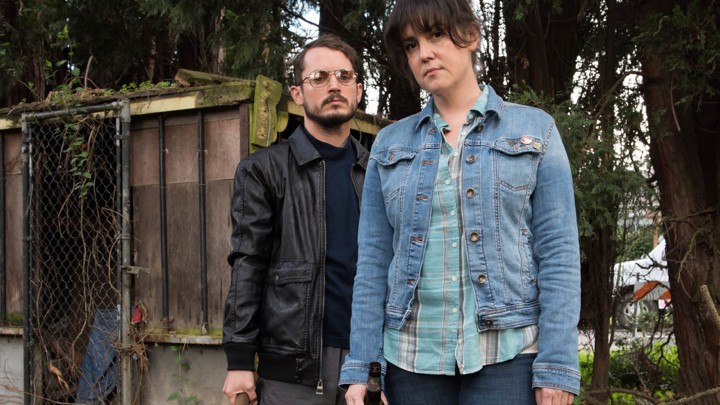
Melanie Lynskey has been an ever-present on our screens for a quarter-century now without ever really receiving her due. She was the murderous schoolgirl who wasn't Kate Winslet in 1994's Heavenly Creatures; had a spacey (and hopefully well-paid) comic triumph as Charlie Sheen's adorable stalker Rose in Two and a Half Men; and more recently re-emerged on TV in the Stephen King fanfic of Hulu's Castle Rock, having previously hopped around Tinseltown as one of the many eminently capable actresses yet to propel their names above a movie's title. I Don't Feel at Home in This World Anymore., the dark comedy that marks the directorial debut of the actor Macon Blair (star of Jeremy Saulnier's acclaimed indies Blue Ruin and Green Room), is as close as Lynskey's had to an outright star vehicle, and it may be no coincidence that it finds her playing a somewhat overlooked woman seemingly waiting to go off like a volcano. Her Ruthie is a nursing assistant whose professional gentility is tested indeed by the gazillion-and-one passive-aggressions Blair sends her way: dogowners allowing their pooches to poop in her yard, fellow shoppers cutting the queue, people not picking up after themselves. A breaking point of some kind is reached when she returns home after a tough shift to find thieves have ransacked the place and made off with several of her belongings; recruiting an uptight kung-fu enthusiast by way of muscle (Elijah Wood, suggesting a lost Napoleon Dynamite sibling), our heroine zigzags off in search of the ne'er-do-wells responsible, in what comes to seem less a quest for justice than a potentially lethal collision course.

In some respects, that set-up is an outward-bound variation on Green Room: again, it's normies versus nasties, with no guarantees offered as to who will be left standing come the final credits. A funny opening sequence - which finds Ruthie tending to a bedbound crone who goes beyond "comedy racist grandma" to real piece of work - establishes the baselines; what's distinctive about IDFAHITWA - what presumably pushed it beyond the pale of the studio system, and out onto Netflix - is that those ne'er-do-wells prove to be properly nasty, sociopathically selfish small-town shitkickers with fucking terrible haircuts. Yet what Blair has twigged is that there exists a simmering resentment inside even the most right-minded and thoughtful among us, one that, once unstoppered, may explode in directions we cannot control, and prove damaging to anyone within our radius, including ourselves. This lends a peculiar tension to every set-up Ruthie jitters into: Lynskey plays the character as an atom bomb inside a bath bomb, her external powdering of sweetness and light masking an aggrieved and increasingly unstable core. We're struck by how skilfully Blair handles that violence when it finally erupts. From Saulnier, he's inherited a feel for the latent threat of quiet American backwaters, and a recognisable technical clout: lopping the edges off his scenes exposes sharp corners, yanks everybody on screen from their domestic complacency towards the very fringes of civilisation, and brings the viewer closer to the philosophical nub of such matters than a blustering fanboy like Tarantino ever has. When asked by one of her targets what she ultimately wants, Ruthie responds "For people not to be assholes." Blair's wild and strangely engaging film understands that a person could spend their rest of their life pursuing that goal to the ends of the Earth, with nothing to show for it but a mounting frustration.

I Don't Feel at Home in This World Anymore. is now streaming via Netflix.

Saturday, 4 May 2019

1,001 Films: "Wings of Desire" (1987)


It's funny how the movies work. For years, Wim Wenders had been making acclaimed, sometimes literary, essentially realist dramas about flesh-and-blood people in the divided Germany, then he succeeded in hitting a real popular nerve with Wings of Desire, the metaphysical fantasia featuring angels on the rooftops of Berlin that came to serve as the template for the Nic Cage/Meg Ryan romance City of Angels. In Wenders' original, we have Bruno Ganz as the guardian angel who wants to come down off his lofty perch so as to know what it is to feel life, and Solveig Dommartin as the melancholy, earthbound trapeze artist who hastens that desire. Traces of the old, philosophical Wenders remain (on an U-bahn train, one individual can be heard wondering "Why am I living?"), but it feels very much as though the director's keynote existentialism had started to be informed by the heightened aesthetics and romanticism of the then-ascendant cinéma du look. Here is a newly wide-eyed, childlike view of the world that translated very easily into the Americanisation: as both an example of the cinema du look's self-reflexivity and a premonition of the remake, consider the sequence in which Ganz and fellow angel Otto Sander express their adoration for Peter Falk (playing himself) around the set of an American WW2 movie being shot in the city. (In Wenders' world, even the celestial get starstruck.)

In general, these angels are deployed to express an authorial joy in what it is to be mortal, and this remains one of those fantasy movies that - like Godard's Alphaville or Welles's The Trial, or Powell and Pressburger's A Matter of Life and Death (which may be where Wenders got the idea of using black-and-white film for the heavens and Technicolor for the world below) - locates its greatest marvels here on Earth: in the wind rustling the trees, birds flocking in the sky, and in the growing love between two people. You can, I think legitimately, accuse Wenders of getting a shade too wrapped up in his own grand vision: there are two sequences - one in a circus big top, the other a grungy nightclub - that long outstay their welcome. Nonetheless, the writing and playing strike such deep chords in places that you forgive the film its longueurs and pretensions everywhere else, and its use of a pre-unification Berlin is always resonant; the true theme of Wings of Desire is what's going on behind the walls we put up to separate our public and private selves, the present and the past, this world and the next. Claire Denis, later known for creating lush and dreamy images of her own, was the assistant director; Wenders was to try and recapture the magic (and the vast international audience) with 1993's sort-of sequel Faraway, So Close!, but he's never quite managed to top this gorgeous car commercial for the soul.

Wings of Desire is available on DVD and Blu-Ray through Axiom Films, and to stream via the BFI.

Friday, 3 May 2019

For what it's worth...


Top Ten Films at the UK Box Office 
for the weekend of April 26-28, 2019:

1 (new) Avengers: Endgame (12A) **

2 (2) Dumbo (PG) **
3 (7) Wonder Park (PG) **
4 (5) Red Joan (12A)
5 (1) Shazam! (12A) **
6 (3) Captain Marvel (12A) ***
7 (8) Wild Rose (15) ****
8 (13) Missing Link (PG) ***
9 (6) Greta (15)
10 (new) Eighth Grade [above] (15)

(source: telegraph.co.uk)

My top five: 
1. 
Ash is Purest White
2. Styx
3. Long Shot
4. Maborosi
5. The Dig


Home entertainment Top Ten (DVD/Blu-Ray/Download): 

1 (6) 
Spider-Man: Into the Spider-Verse (PG) ***
2 (1) Mary Poppins Returns (U) ***
3 (9) Avengers: Infinity War (12) ***
4 (11) Mortal Engines (12)
5 (2) Aquaman (12)
6 (3) Bohemian Rhapsody (12)
7 (15) Ant-Man and the Wasp (12)
8 (new) The Favourite (15) ***
9 (19) Black Panther (12) **
10 (4) Ralph Breaks the Internet (PG)

(source: officialcharts.com)

My top five: 
1. An Impossible Love
2. Minding the Gap

3. The House by the Sea
4. Fahrenheit 11/9
5. The Man Who Killed Hitler and then the Bigfoot

"Long Shot" (Guardian 03/05/19)


Long Shot ***
Dir: Jonathan Levine. With: Charlize Theron, Seth Rogen, June Diane Raphael, O’Shea Jackson Jr. 125 mins. Cert: 15

Last week, the New York Times ran the latest in a recent run of arts-section thinkpieces mulling over the reasons romcoms no longer enjoy the traction they once had. Jonathan Levine’s Long Shot arrives as a reasonably witty riposte to such handwringing, and an acknowledgement of some of the issues such pieces have outlined – chiefly that lasting movie love, as with real love, requires sustained hard work. Until a final-act slackening of narrative control, it does a generally sound job of persuading us there might be a world where a journo-turned-speechwriter played by Seth Rogen would be a good match for Charlize Theron as the sparkling Presidential candidate who also babysat Rogen as a teenager. Residual scepticism will have to be weighed against a consistent rate of laughs.

Levine and screenwriters Dan Sterling and Liz Hannah have at least been taking notes from reality. Rogen’s Fred is introduced working undercover at a white supremacist gathering, his half-hearted Hitler salutes early reassurance we’re in for a good time; Theron’s Charlotte is touting an Ocasio-Cortesian green deal, keenly aware that any elevation of her voice will be attributed to hysteria by a rabidly right-wing commentariat. (Andy Serkis finds a worthy post-Gollum persona as the scabrous Bannon-alike targeting our heroine.) Levine, building on his good-natured The Wackness and 50/50, counters that reactionary harrumphing with an optimism that has been in short supply of late, both in the cinema and beyond: his more improvised set-ups exemplify the wider editorial faith in the ability of individuals to work things out for the best.

Old-school star power gets us some way there. Casting Theron as a statuesque alpha is no stretch, yet the fun here lies in watching this performer relax around Rogen in a way few recent projects have allowed her to do. (And unlike Katherine Heigl’s TV producer in 2007’s less-than-gallant Knocked Up, she doesn’t sacrifice much for the privilege.) Belatedly, matters get tangled up in image issues more pertinent to film stars than filmgoers, and the pushing through of plot involves compromises on the comedy. The near-stock image of Charlotte nursing open Haagen-Dazs to the strains of Roxette’s “It Must Have Been Love” is presented with a jarring lack of irony. Still, Levine succeeds in giving some genre tropes renewed sheen: even a rote-seeming, Rogen-initiated drug trip pays off with the cherishable sight of Theron conducting state business with glitter in her hair.

Long Shot opens in cinemas nationwide today.

"A Dog's Journey" (Guardian 03/05/19)


A Dog’s Journey **
Dir: Gail Mancuso. With: Dennis Quaid, Betty Gilpin, Marg Helgenberger, Kathryn Prescott. 108 mins. Cert: PG

This week’s dogtainment is the sequel to 2017’s A Dog’s Purpose, the Lasse Hallström holiday timekiller chiefly notable for its faithful translation of author W. Bruce Cameron’s bizarre concept: its onscreen walkies were narrated by a free-floating canine spirit (bearing the voice of Frozen’s Josh Gad) who jumped from dog’s body to dog’s body like Scott Bakula – Barkula, maybe? – in some canine Quantum Leap reboot. On a second runout, that USP seems less eccentric, but equally some of the oddball novelty has worn off. Four credited screenwriters – including former Simpsons scribes Maya Forbes and Wally Wolodarsky, upping the poop-joke quotient – merely use that astral projection to usher another conveyor belt of pooches through much the same cornily conservative scenarios the studios churned out in Rin Tin Tin’s heyday.

Only its restlessness feels entirely novel, tailored as it is to wet-nosed viewers made distractible by hours of scrolling through floofcentric Instagram feeds. Bailey, Spirit Gad’s ultimate destination first time round, has settled on the ever-workshirted Dennis Quaid’s perpetually sundappled farm, yet – tissues at the ready – he hasn’t long for this world. Our spirit guide must thus find his way back in another form, an odyssey that entails shepherding Quaid’s songbird granddaughter Clarity Jane (Kathryn Prescott) away from G.L.O.W.’s Betty Gilpin, marked as a Bad Mother by her tendency to liberally decant Pinot Grigio in the hours before sundown. Here we spot evangelically minded producers Walden Media’s pawprint: images of Bailey bounding through a celestial wheatfield, as if in an ad for some new, consecrated Winalot Prime recipe, push the dog-as-guardian-angel line further still.

Any cheap tears can be attributed to the way Cameron’s writing rubs up against earthlier experiences: seeing out thunderstorms alongside one’s pet, sudden health crises, ominous visits from the vet. (The finale goes full-blown Six Feet Under, with Mark Isham’s score shamelessly recycling Sia’s “Breathe Me”.) Yet as signalled by one character’s cursory cancer treatment, there’s nothing much for the human performers to sink their teeth into: Quaid eventually succumbs to comical old-age latex, having long ceded the screen to the slobbering selling points. By their very nature, dog lovers may be more forgiving and enthusiastic, but between 80-90% of it is reaction shots of trained mutts; right through to the closing-credit snapshots of the crew’s “Forever Friends”, the movie is almost literally all puppy eyes.

A Dog's Purpose opens in cinemas nationwide today.

Thursday, 2 May 2019

Closure: "Avengers: Endgame"


There's not much time during the overstuffed Avengers: Endgame to consider the legacy of the Marvel Cinematic Universe. What have we been left with? A sum total of 22 films, most of which have functioned on some basic audiovisual level, very few of which (looking at you, Cumberstrange) have been dead losses; a new gold standard in rights management; a decisive placing of a concern as niche as quilting or crown green bowls - comic books - at the centre of the cultural mainstream; and the emergence of a superstudio (in Disney) capable of swallowing any of its rivals. Being an offshoot of late capitalism, a last-gasp push for the primacy of the collective big-screen experience before our multiplexes moss over and everybody retreats to Netflix, any MCU good has had to be taken with the bad. Back in 2012, I titled my Avengers Assemble review "Big Bullies", and parsing this week's listings - and seeing the struggles of even a well-reviewed, hardly artsy release such as Eighth Grade to find showtimes - I see no reason to revise that. The past twelve years have also witnessed a decline in critical rigour (so many reviews that amounted to no more than the children's-book couplet "look at the big movie/isn't it big?"), partly linked, as Catherine Shoard posited in a recent Guardian editorial, to the emergence of a mewling fanboyism ready to pile onto anyone who doesn't hold to the established line of cheerleading. In the past few days, the MCU has also prompted a poignant two-part Twitter anecdote: that of the autistic cinema worker who posted photos of the tonnes of rubbish left behind by consumers at early Endgame screenings, then announced they felt obliged to quit after this punishing opening-weekend shift in a bid to preserve their mental and physical wellbeing. One question this series has habitually ducked, like a well-rehearsed CEO, is who pays for the Avengers, and who cleans up after them. The answer, as demonstrated several times over in the course of the past week, is people like us.

We can all agree, at least, that the series has represented spectacularly canny business. In retrospect, it seems especially telling that the lynchpins of its first cycle were Tony Stark (a.k.a. Iron Man), an arms-dealing opportunist only humanised over successive instalments by the very great skill of a newly sober Robert Downey Jr. (one unarguable benefit of these movies: restoring this crafty, intuitive performer to full working order), and Steve Rogers (a.k.a. Captain America), dreamy posterboy for American military supremacy. Subsequent spin-offs and offshoots could pay lip service to social shifts - so there were black superheroes and female superheroes and, in Endgame, a canonically gay character handed a full three lines of dialogue - while adhering steadfastly to stout Republican logic. These movies, even the troubled Ant-Man, came in on time and budget, secured the release dates, promo slots and censor ratings required to ensure maximum visibility, and became licences to print money; unlike the more variable films of comic-book rivals DC, they earned a reputation as worthwhile investments, both for those bankrolling them and for the casual weekend cinemagoer, who knew he or she could hand over a tenner and see something on screen that would distract them from Trump or Brexit for a couple of hours. That last factor, though, suggests how this Universe has at best been apolitical - Black Panther's most immediate beneficiaries would have been Disney's majority white shareholders - and of the near-sixty hours of sound and Nick Fury the MCU has drummed up, only a handful of frames could legitimately be claimed as pop art comparable to the comics that inspired them, most of those from one of the few movies (the comedy Thor: Ragnarok) that wasn't straining for earthshaking narrative significance.

That sense of indulged and indulgent sprawl returned to me while ploughing through Endgame's 181 minutes the other night. In the 1990s, that sly romp Con Air received a measure of critical opprobrium for so flagrantly tacking on a final twenty minutes intended to sate its audience's bloodlust by killing off big bad John Malkovich in a grislier manner than was first floated. Endgame, less sly than calculated, could theoretically run its end credits after twenty minutes - the natural conclusion to the Thanos narrative set out in last year's Infinity War - but instead goes through hoops for another two-and-a-half hours, attempting to please those fans who've stayed the course by offering sendoffs to each of the 1,546 characters and hangers-on collected in the first 21 films. A few of these, granted, merit the extra time: the newly corpulent Thor, sent to comfort food after the tragic events of the previous movie, serves to symbolise how Chris Hemsworth has spent the past decade fleshing out what initially seemed an unpromising sketch of a character into jovial, even Falstaffian good company. One Captain America has always been more than enough for this correspondent, however, and the emergence of a double - via the timetravel device writers Stephen McFeely and Christopher Markus use to reboot the plot - only set me in mind of the apocryphal story about Mike and Bernie Winters' disastrous appearance at the less-than-welcoming Glasgow Empire ("Christ, there's two of 'em"); while I'm on this particular tear, I'm also of the opinion that Thanos (Josh Brolin) could equally purge the planet of the remaining 50% of its population, and Hawkeye (Jeremy Renner), Black Widow (Scarlett Johansson) and the Scarlet Witch (Elizabeth Olsen) still wouldn't be the most interesting things anybody could stick a camera on.

At any rate, no moral high ground is gained in taking this circuitous route back to Infinity War: the development merely enables more Avengers to pile on Thanos, like fanboys on any sceptic questioning whether the MCU's cultural footprint might be a tad disproportionate, and returns us where we were after the first twenty minutes, only in greater need of a wee. While not quite as egregious as the "it was all a dream" faceplant of the final Twilight instalment, the time travel is a cheat nevertheless, and one that requires so much explanation amid that dingy production design that has become a series feature. (Again, can any run of movies derived from a visual medium have been so consistently dull to look at?) Devotees have evidently been delighted by the replay of arcane series highlights that results, but heading into the fourth hour of watching grown adults setting out in search of magical coloured stones, I had to ask: really? After the minor yet appreciable dramatic achievements of Infinity War, it's a disappointment to see McFeely and Markus taking back some of that development - but then maybe they knew the squealing fatwas that lay in store for them if they didn't bend over backwards to give the fans what they wanted. After 22 films, of course, you're either in or out - and clearly the financial bottom line is that enough people are in to give Endgame the first billion-dollar opening weekend in motion-picture history, a yardstick for a moment that (like the film's finale, swarming with often naffly rendered ones and zeroes) has been about nothing if not the numbers. 

The creative bottom line, however, is that this is a series that, to the last, has demanded some form of investment in the fate of a pixellated raccoon; as an admirably well-adjusted pal put it, "I have limited hours on this Earth, and spending 34,649 of them watching CG buildings being smashed does not appeal to me." (In Endgame's defence, its final battle takes place around the same dismal, uninhabited wasteland as Infinity War - a fine visual analogue for where we might now be in the culture wars - so any collateral damage will be limited to your eardrums.) I can grudgingly admire the logistical achievement - that boxset will look impressive under the Christmas tree - but forgive me for not wanting to cheer wildly as the studios abandon the practice of making movies for grown-ups and instead persist in clubbing us over the head with monthly bouts of Lite-Brite spectacle intended to reduce us to goggle-eyed, credulous infants. One of the reasons the MCU films have reopened the desperately dull debate around spoilers (another crime) is that they've been so easily spoiled: their effects ephemeral, their narrative chicanery flimsy, they beg to be knocked down as Thor does Thanos. Endgame's self-justification extends to a long walk around the VFX houses and a final zigzag up the garden path - past characters we were never properly introduced to, characters who were barely even there - intended to lend an epic dimension to a decade-long soap opera that ultimately came down to a gesture as arbitrary and trivial as a billionaire clicking his fingers. Our rattled corporate overlords can rest easy knowing that a significant swathe of humankind is still prepared to respond so favourably to such nothings; yet faced, over three hours more exhausting than exhilarating, with the prospect of showtimes opening up, hundreds of creatives being freed to pursue more adventurous and challenging work, and indeed of the return of an entirely organic, non-CG Mark Ruffalo, I found my thoughts aligning not with Cap'n America, but Captain Sensible: glad it's all over.

Avengers: Endgame is now playing in cinemas nationwide.