Friday, 26 April 2019

Dirty work: "Loro"


What's billed as the new Paolo Sorrentino film, Loro, is actually two films in one - or, rather, a selected highlights package of same. Sorrentino's first project after floating The Young Pope onto our satellite channels was conceived as a diptych of features, each one around 100 minutes in length, on the rise to power of Silvio Berlusconi; after their domestic release, these were edited into one two-and-a-half-hour movie for easier international consumption. The results display an unevenness and eccentricity that are as much to do with form as content. Sorrentino retains both the interest in Italian power structures he demonstrated with The Family Friend, the Andreotti biopic Il Divo and the coda of The Great Beauty, and that most un-A.J.P. Taylor-like fondness for recreating the above in the kind of brightly lit, fast-cut, ADHD-inducing images more commonly associated with pop promos and ad campaigns. Not for Sorrentino the austerity of a Roberto Rossellini when it comes to excavating the past; instead, he dives into altogether enthusiastically into the corruption and toxicity of the Berlusconi years. The extensive legal disclaimer placed very carefully before the main feature is the last time for 150 minutes you could Loro of being circumspect.

Its line of approach is perhaps its most measured aspect. Berlusconi himself will eventually assume centre stage, played by chameleonic Sorrentino fave Toni Servillo as a free-roaming Cheshire Cat grin supplemented by liberal applications of hair oil, yet for much of the first hour, we find ourselves in the dubious company of Sergio (Riccardo Scamarchio), a small-time pimp with aspirations of becoming a political player who embodies the flaws of the system that held Berlusconi up. Silvio has the power, pulling Italy's strings from the lakeside villa that served as his Mar-a-Lago, but the upwardly mobile Sergio grants the film access: to the well-to-do chatterers hymning the country's newfound "economic energy", and to those sex workers offered up to politicos as a way of securing crucial votes. It's a smart, clear-eyed authorial move, underlining how it took more than one man to throw a bunga-bunga party, and that Don Silvio was but the tip of an especially grimy and compromised iceberg. On set, however, Sorrentino looks to have succumbed to more sensational instincts. Nothing represents Loro as a whole more than the look Sergio gives the camera around ten minutes in while banging one of the girls we've just seen him offer as a bribe, a look that both acknowledges that his is a filthy business, while also seeming to ask the viewer whether they, too, wouldn't love a bit of this. Consider that advance warning of a decidedly horny history - or at least a history that comes on strong, as per Berlusconi legend. Adhering to Sergio's catchphrase "Show me a tit", there's barely a frame in the opening 45 minutes without a mammary thereabouts; your mileage thereafter will depend on the extent to which you find this representative rather than exploitative, and whether even "a bit", in this context, strikes you as too much.

It both helps and hinders that this international cut is such a ragbag; possibly Sorrentino himself wasn't sure what form this material should best take. (I could see clear episode breaks in here - and on TV, it wouldn't seem quite so weird that Sergio disappears for an episode or two.) The single-sitting Loro hits upon extraordinary sights and sequences: a mysterious prologue involving a lamb, a quiz show and an air con unit; a bald-pated PA who suggests a Mediterranean brother to Robert Blake's character in Lost Highway; an exploding garbage truck that seems to cover the whole of Italy with its contents; a recreation of the 2009 L'Aquila earthquake that chimes with the theme of a country being shaken to its rotten foundations. (Sort of brilliant, too, that a film in which an ageing satyr promises to show one young visitor a real-life volcano erupting should instead climax with a papier-mâché replica sputtering out.) And it seizes upon patches of revealing, instructive writing: Berlusconi refuting his grandson's observation that he's just stepped in poop - insisting that he could never step in poop - because only a mediocre mind would believe such a thing, positioning himself as post-truth before the fact. (I also liked Silvio telling Sergio to make sure his bunga-bunga girls eschew the wearing of high heels as "we're not very tall".)

That these isolated moments pop out so, however, is in part down to the film's wafflier, less effective writing and superfluous scenes of bacchanalia, which survive into this cut long after a point has been made. The unreconstructed breastiness is one thing; I personally could also have done with far less of Silvio's singing, although I suspect his houseguests would have thought the same thing. Throughout, we're dangerously close to seeing a national tragedy being replayed as a joshing diversion of the kind Berlusconi's own TV networks dealt in, a feeling only heightened when Servillo pops up in a second role as a businessman keen to finance Berlusconi's political progress. Editorial is being generated here about the kind of tinpot chancers restyling themselves in this Teflon despot's image, but mostly it's a comedy turn in a film that doesn't appear unduly concerned with the sufferings of the Italian people. Sorrentino, granted, makes the regime's superficiality - the slick salesmanship that made fools of millions, the eyecatching surfaces concealing all manner of crimes and misdemeanours - dazzlingly apparent. Yet just as some felt Scorsese's The Wolf of Wall Street was all too readily available for misappropriation by braying city yahoos, you sense Berlusconi wouldn't be unduly miffed by this lengthy portrait of himself as a master manipulator surrounded by pretty girls with their bits on display like game-show prizes. No legal action has as yet been taken against Loro; in our era of shamelessness, there may be no longer be such a thing as bad publicity. Sorrentino, for his part, emerges from the edit suite with his reputation as a remarkable imagemaker intact, yet questions continue to linger as to whether those images hold much of real substance, and add up to anything more than the shiniest, most flattering of mirrors.

Loro is now playing in selected cinemas, and streaming via Curzon Home Cinema.

Tuesday, 23 April 2019

On demand: "Shirkers"


The Sundance-feted documentary Shirkers belies its initially dreamy, scatty voiceover to tell a story that eventually connects up with several themes floating around in the zeitgeist. It opens, however, with a woman now in her early forties - the film's director Sandi Tan - looking back on her formative days in the hot, stifling, censorious Singapore of the late 1980s. The teenage Tan was a passionate cinephile with a particular love for the emergent American independent cinema - films one would have to go out of one's way to experience in a place where the Government routinely banned such provocations as chewing gum. Still, Tan persevered, and at some stage in the early 1990s, she recruited a small and devoted band of friends and fellow travellers to shoot "Shirkers", a microbudget road movie inspired by the US trip she'd taken in the company of her college professor, a mysterious, rather unplaceable fellow by the name of Georges Cardona. How that production came to unravel forms the meat of this tale, and is best left for you to discover; all I'll say here is that there are reasons why the doc became a small phenomenon among the denizens of Film Twitter. It's not just that Tan is easily embraced as one of us (a teenage cinephile who flirted with production before becoming a critic); it's that her story mirrors the sometimes fractious relations between cinephilia's male and female contingents.

The revelations come late on, and then thick and fast. What's positioned upfront is notable for its zippy, peppy style. A graduate of those punk fanzines that circulated among the Singaporean underground, Tan here introduces herself to a wider audience as a notably gifted collagist, energetically stitching together childhood odds and sods (the diaries, the posters, the angry missives composed in pink felt tip) to corroborate her truth. The clips we see of "Shirkers" the fiction, complete with dancing dogs and Luhrmann-pipping shots through fish tanks, display a marked fondness for bold colours and off-kilter framing; in indie terms, they would suggest the David Lynch of Blue Velvet remaking Jim Jarmusch's touchstone Stranger than Paradise. (Bottom line: we will all have suffered through far less promising student films - and Tan makes a point of contrasting "Shirkers" with the hackneyed professional films coming out of Singapore at that time. Royston Tan and Eric Khoo, whose films proposed some kind of Singaporean New Wave when they slinked off the festival circuit and into Western cinemas in the early Noughties, were themselves making their bones at this stage.) What we don't know, and what only becomes clear in the documentary's second half, is that we're lucky indeed that any of these images survived. 

Tan emerges as an exceptionally patient and inventive storyteller, relaying the facts in her own idiosyncratically sing-song voice (no surprise to learn she achieved success as a novelist before returning to movies) while finding funny surrogates for the increasingly elusive Cardona: the villains defeated by local heroine Cleopatra Wong, say, or puppets that speak to the young Sandi's love of Jim Henson. What's clear is that cinephilia, the keeping of some kind of faith, allowed Tan to retain a kind of innocence through the rocky rite-of-passage that second half describes. Given the betrayal this entails, it wouldn't be especially hard to imagine an angrier retelling of this story, yet our narrator comes over as part-Agnès Varda, part-Nancy Drew, following a decade's worth of clues to solve a mystery, while insisting things will work out for the best; her tone is less bitter than bittersweet. Another reason Shirkers may have been taken so to heart: unlike so much online and real-life interaction, it does wind up with a happy ending of sorts. It becomes clear that Professor Cardona taught Sandi and her pals lessons no-one was paying him to teach: that men can be colossal timewasters and dreamwreckers, and that women are often obliged to work twice as hard to get anywhere within an industry that began as a boys' club, and became a playground for chancers, swindlers and frauds. The happy ending is that Tan finally brought a movie called "Shirkers" to the screen; you'll just have to grit your teeth at the realisation it was a quarter-century after it should have been with us.

Shirkers is now available to stream via Netflix.

Monday, 22 April 2019

From the archive: "Maborosi"


Maborosi, the debut feature of director Hirokazu Kore-eda (After Life, Nobody Knows), is an enigmatic, slightly diffuse drama about a young mother (Makiko Esumi) whose husband is killed by a train in an accident that may also have been a suicide. Understandably shocked, she relocates from the city to a desolate stretch of the coast, rebuilding her life from scratch by acquiescing to what amounts to an arranged marriage. Technically, it's faultless. Kore-eda demonstrates a masterful use of screen space to convey perspective, and a precise attention to every last detail: you'll note the overhead train tracks looming over the widow's apartment in the early scenes, and how every passing locomotive serves as a cruel reminder of her childhood sweetheart's fate. Classical screenwriting ensures every scene serves to set up some element of the next, although at this stage in his career, Kore-eda was still rather too in thrall to Ozu in his pacing and plotting: the whole could probably do with at least 10% extra narrative oomph to help us connect some intriguing dots, just as surely as the film's heroine comes to make a sense of sorts from the disparate facts of her life.

(January 2007)

Maborosi returns to selected cinemas from Friday as part of the BFI's Kore-eda season.

On demand: "Black Dynamite"


2009's crafty blaxploitation spoof Black Dynamite mitigates against the intrinsic thinness of pastiche - that sense everything we're watching is a goof, that nothing really matters - via its tremendous, near-scholarly attention to detail: it's a far smarter and more considered revival of the Seventies grindhouse aesthetic than either Tarantino or Robert Rodriguez managed in their slapdash, fanboyish Death Proof/Planet Terror double-bill. Director Scott Sanders and co-writer/star Michael Jai White have taken a decade's worth of Shafts and Superflys (and, most crucially, the opportunistic knock-offs than followed in those films' wake) and boiled down an entire cycle to its most basic and amusingly absurd tropes. Investigating the murder of his undercover brother, our sexually potent pimp-enforcer hero (played by White with the straightest face since Leslie Nielsen, and a rippling physique that's quite the sight gag) hustles on slightly degraded film stock through clunky exposition, shonky chase scenes, and bits where the character stands up too quickly for the camera, inadvertently bringing a hapless boom mic into shot. You may wonder how anybody ever took this cycle seriously in the first place - but we shouldn't forget the originals were possessed of a certain energy, wayward as it often was, and that they offered a form of representation hitherto unseen in mainstream American movies.

It takes alchemy to transform this here-today-gone-tomorrow tat into a coherent, seductive style, and Sanders has it. Whether he's reaching for rear projection, split screen or stock footage, not a single frame here, nor a performer within them, looks or sounds out of place. The afros and costumes (the latter care of the Black Panther-bound Ruth E. Carter) are just so; the soundtrack stings are aptly funky and cursory; even the especially diffuse light looks to have been bussed in from 1974. The narrative may be no more than a sketch with legs, but it never quite tires itself out, instead running into new areas of inquiry (not least the very funny idea that an unstoppable sex machine like White's Dynamite may have spawned illegitimate children every which way he turns) and catching the crazy tonal shifts blaxploitation undertook as it broke out of the margins and flirted with the movie mainstream. A sequence where Dynamite seduces a nurse ("Let me pull out my own thermometer") before schmoozing the head of an orphanage where a third child has died from ingesting smack being peddled by ninjas hellbent on reducing African-American penis size spots how this subgenre could tessellate with both porno and social issues, the kung-fu flick and the revolutionary tract alike. What on earth was everybody drinking back then? More importantly: does anybody know where the current cinema might get some?

Black Dynamite is now streaming via MUBI UK.

Sunday, 21 April 2019

From the archive: "The Two Faces of January"


Unlikely as it may sound, we have the success of 2011’s gaudy vengeance saga Drive to thank for The Two Faces of January, the latest drama to be drawn from the works of author Patricia Highsmith. Scripting Refn’s film reportedly opened the door for writer Hossein Amini to make his directorial debut, yet Two Faces equally harks back to an earlier Amini script, for Iain Softley’s very fine 1997 adaptation of The Wings of the Dove: again, we’re faced with a film that draws not inconsiderable pleasure from the myriad betrayals of increasingly desperate characters.

It opens in the Athens of 1962 – a golden, sunkissed moment – where American tour guide Rydal (Oscar Isaac) takes time off from scamming female tourists to squire a well-heeled couple around the ruins. First impressions suggest Chester and Colette (Viggo Mortensen and Kirsten Dunst) are merely upmarket marks, patsies with a little more green than Rydal’s usual targets; the conman speaks the local tongue, where his new charges don’t. Yet Chester proves to be running his own scam, which has brought them here – and why, when the past catches them up, it does so with deadly consequences.

To reveal more would do scant justice to Amini’s superbly relaxed, assured storytelling, which prefers fostering intimacy to Highsmith’s narrative chicanery. We spend the best part of the first hour, like Rydal, just hanging out with this in-crowd: feeling the sun on our skin and the breeze on our backs, watching this threesome hop from island to island, knocking back the ouzo and eyeing one another up. What could be more seductive?

Already, though, there is an intriguing ambiguity as to which of the couple our guide is more attracted to: all-American cheerleader Dunst, the very picture of a trophy wife? Or is it Mortensen’s upright, generally unruffled Chester, who apparently reminds the recently orphaned Rydal of his stern and unforgiving father?

Engaged performers chart the fluctuations within these relationships: Isaac, as with Llewyn Davis, very much the outsider who wants in, yet keeping Rydal distinct from Highsmith’s triumphant Tom Ripley in his determination to turn even his character’s rare winning hands into busted flushes; Mortensen flexing his knuckles and jaw in ways that insinuate the ruthless steeliness beneath the pressed-suit sophistication; Dunst working hard to make interesting and finally precious a gal mostly here to be steady and true.

Amini realises that with this trio, he doesn’t have to whirl his camera about to get an effect, and so sets about subtly underlining, rather than overwriting, his choices with this text. Practically classical in his editing and shot selection – constructing, for example, a tense passage through Greek customs via a succession of slowburn looks and glances – he’s supremely attentive both to his location, sending his characters out into a parched and rocky landscape just as matters are beginning to hot up, and to how costume might reveal (or conceal) character: hats and sunglasses abound.

Not that it should count for anything much, given the underlying thematic assertion that surfaces can be deceptive, but such considered, detailed handling ensures The Two Faces of January may just hold out as the handsomest film of the year: a deft conversion of a well-thumbed paperback into the kind of intelligent, toney, high-class entertainment you’d almost forgotten the movies were capable of.

(MovieMail, May 2014)

The Two Faces of January screens on Channel 4 tonight at 1.10am.

Friday, 19 April 2019

For what it's worth...


Top Ten Films at the UK Box Office 
for the weekend of April 12-14, 2019:

1 (2) 
Dumbo (PG) **
2 (1) Shazam! (12A) **
3 (new) Wonder Park (PG) **
4 (new) Hellboy (15)
5 (4) Captain Marvel (12A) ***
6 (new) Wild Rose (15) ****
7 (3) Pet Sematary (15)
8 (new) Little (12A)
9 (6) Us (15) ****
10 (7) Missing Link (PG) ***

(source: theguardian.com)

My top five: 
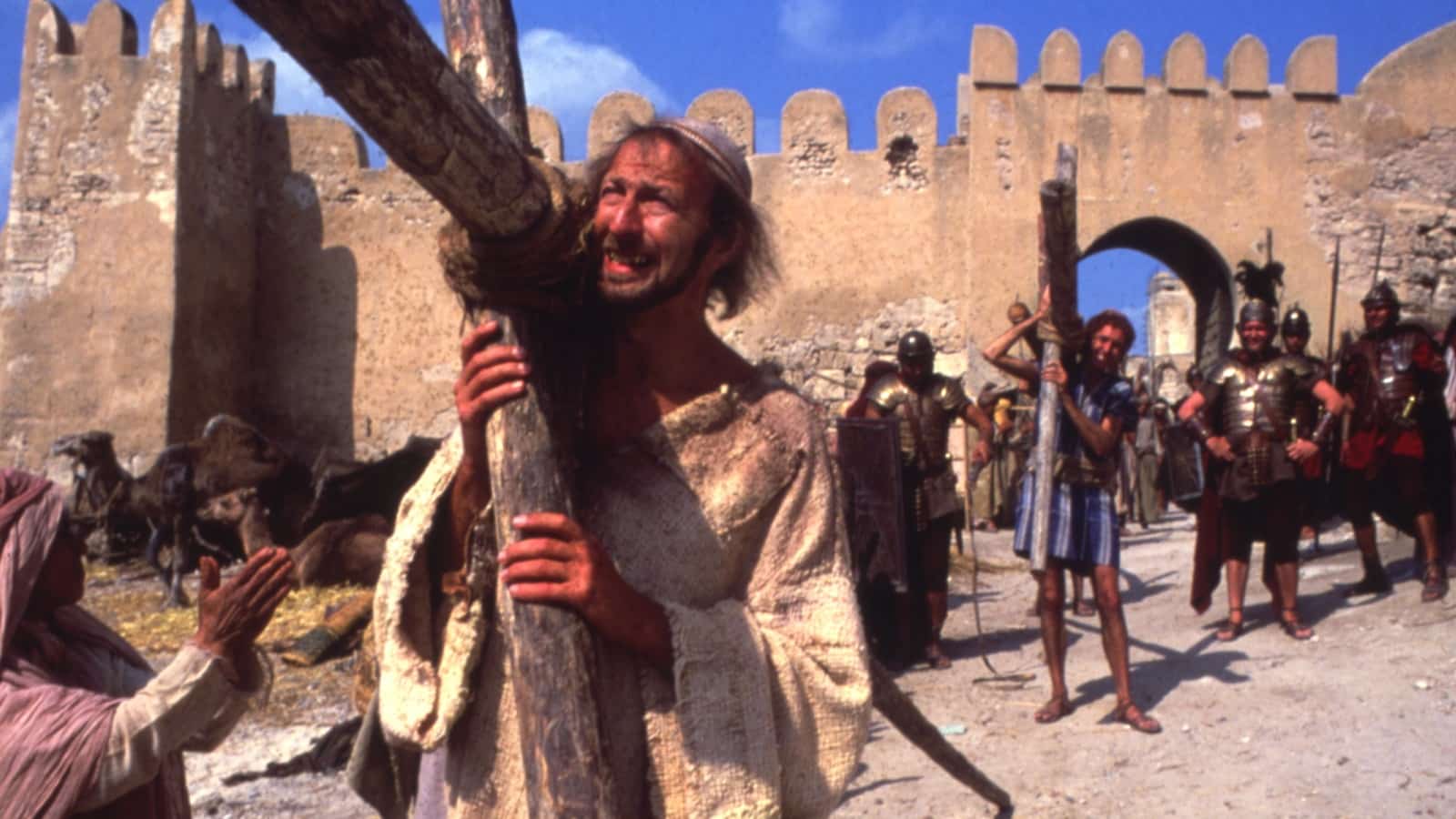
1. Monty Python's Life of Brian [above]

2. Wild Rose
3. The Sisters Brothers
4. A Clockwork Orange
5. Kalank


Home entertainment Top Ten (DVD/Blu-Ray/Download): 

1 (new) Aquaman (12)

2 (1) Ralph Breaks the Internet (PG)
3 (2) Bohemian Rhapsody (12)
4 (4) Spider-Man: Into the Spider-Verse (PG) ***
5 (3) Fantastic Beasts: The Crimes of Grindelwald (12)
6 (new) Mortal Engines (12)
7 (13) Venom (15)
8 (7) A Star is Born (15) ***
9 (5) Creed II (12)
10 (6) Robin Hood (12)

(source: officialcharts.com)

My top five: 
1. An Impossible Love
2. The House by the Sea

3. Spider-Man: Into the Spider-Verse
4. Mary Poppins Returns
5. Sorry to Bother You


Top five films on terrestrial TV:
1. Heal the Living (Easter Monday, C4, 2am)
2. Notting Hill (Easter Monday, ITV, 10.20pm)
3. The Raid (Friday, C4, 12.35am)
4. Willy Wonka and the Chocolate Factory (Saturday, five, 2.30pm)
5. The Two Faces of January (Easter Sunday, C4, 1.10am)

"Kalank" (Guardian 19/04/19)


Kalank ***
Dir: Abhishek Varman. With: Varun Dhawan, Alia Bhatt, Aditya Roy Kapoor, Madhuri Dixit. 166 mins. Cert: 12A

With this week’s oddly titled Kalank (“Blemish”), we find Bollywood in something of a pickle. Since the runaway global success of the two-part Telugu epic Baahubali, Indian producers have followed a bigger-is-better credo, drumming up a succession of thunderous historical throwbacks, like January’s Manikarnika, which summoned multitudes of extras but precious little of their inspiration’s poetry or wonder. Audiences, understandably, began to gravitate instead towards more personal stories and pithier genre fare, such as surprise-pregnancy comedy Badhaai Ho and horror sleeper Stree. This extraordinarily lavish soap feels like mega-producer Karan Johar’s last-throw attempt to force the issue, recruiting as it does major stars to enact a tangled domestic drama against the backdrop of Partition. Only the opening weekend figures will show whether it’s succeeded.

Writer-director Abhishek Varman has a compelling premise – a household rearranging itself alongside a country – but spends most of the first half trying to bolster his naggingly flimsy narrative foundation. You may simply not buy that, in 1944, the dying wife of a prominent newspaper editor would invite kite-catching free spirit Roop (Alia Bhatt) under her roof to serve as an eventual replacement; equally, that the younger woman would accept, resigning herself to gazing mournfully at the world from a decorous window seat. Offering this self-caged bird some possibility of escape: Varun Dhawan as a hunky, oft-shirtless blacksmith, and local legend Madhuri Dixit, typically captivating as a disgraced courtesan teaching dance out of a studio that makes Kensington Palace look like a two-bed council flat.

That set alone underlines Kalank’s status as a superlative piece of film craft, one that rolls off several of the most beauteous shots the eye will have the good fortune to alight upon in 2019. Whether the human drama scales up to it is questionable: even the intelligent, expressive Bhatt can’t make complete sense of Roop’s self-abnegation. (Her thoroughly modern screen persona isn’t a natural fit with the film’s fusty sexual politics.) With its clifftop bullfights, expansive Pritam songs and squillion-rupee tealight budget, nobody’s likely to emerge feeling shortchanged. Yet the sight of multigenerational superstars navigating a messily unravelling plot suggests Kalank’s lasting value may be as a carefully colour-graded selfie of an industry – and, in this election year, perhaps an entire nation – in flux. 

Kalank is now showing in cinemas nationwide.